AI Photography for Caribbean Restaurant Menus
What separates one Caribbean listing from the next is sealed inside a pastry or buried under the same bed of rice and peas. On this menu the variable is the smallest thing in the frame.
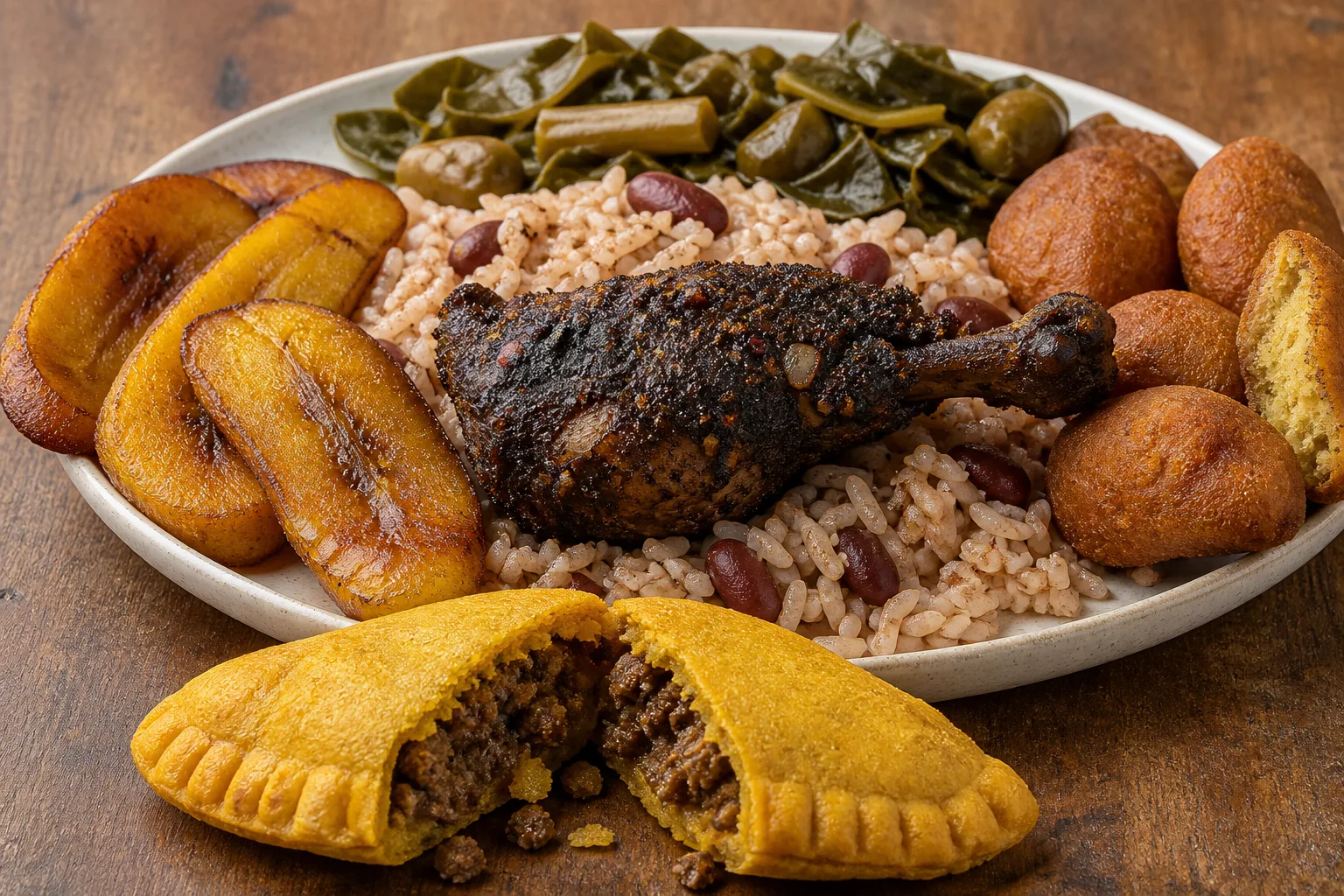
On a Caribbean menu, what makes one listing different from the next is somewhere the camera cannot reach: sealed inside a pastry, or occupying the smallest part of a plate that repeats across every main you sell.
A patty tells you nothing about itself
DoorDash lists duplicates among its eleven named rejection reasons: every unique menu item needs its own photo, and reuse is permitted only for the exact same item — its example, a Beef Taco and a Chicken Taco. Sources are in our DoorDash photo requirements guide.
A taco at least shows its filling. A patty does not. Beef, chicken, callaloo and shrimp are the same crimped, turmeric-yellow half-moon, and the product claim sits under the crust. Photographed intact, four listings produce four copies of one photograph.
The shape is the easy part. A patty is compact and flat, so it crops the way a whole pizza does — nothing lost in 16:9, nothing lost when the square lands, which the pizza page works through. The crop is not this item's problem. Its identity is.
So the filling has to be in the frame: break one patty, turn the open face to the camera, keep the other half beside it. At least 80% of the item must be visible and the item must fill 50% to 70% of the frame, so a tight crop into the filling fails from one side and a lone half in negative space from the other.
The variable is the smallest thing on the plate
The plate is the other half of the menu: jerk chicken, curry goat, oxtail and brown stew chicken, each over the same bed of rice and peas with plantain and festival. The protein is the only thing that changes, and it is a minority of the plate.
The framing rules make that a photographic problem. The item must fill 50% to 70% of the frame and be at least 80% visible, and the item is the plate the listing sells — cropping to the meat frames a dish you do not sell, which is where misrepresentation starts. The repeating part is in the photograph by rule.
That plate is also several foods in one image, which Uber Eats item photos do not allow — the BBQ platter page covers the two-set answer that constraint forces.
Let the square crop delete the part that repeats
DoorDash accepts 16:9 landscape only, then centre-crops that file for the 1:1 thumbnail some surfaces display. Whatever sits at the left and right edges of the upload is discarded on the way there.
That crop is a free editor, and here it should be pointed at the rice. Plate the protein across the horizontal centre, on the bed rather than beside it, and push the plantain and festival toward the edges the square will trim. The upload still shows the whole plate; the thumbnail shows what differs.
Jerk char only survives as a highlight
Char is what this cuisine sells and it is nearly black, which removes the tool that makes food look three-dimensional: modelling is a gradient from lit to unlit, and a surface at the bottom of the tonal range has nowhere darker to go.
What is left is specular. Jerk skin is glossy where the fat has rendered, and side light raked across it breaks into bright, irregular highlights that trace the crust. Those highlights, not the colour, separate charred from merely dark.
Dark food looks best on a dark ground, but DoorDash names solid colour fills and composited backgrounds as rejection causes and accepts white only when it looks natural. The ground has to be a real mid-tone surface, darker than the plantain and lighter than the char. Lighting is a judged category with no published threshold, so there is nothing to appeal to when a reviewer calls your jerk chicken a silhouette.
Festival, fried plantain and escovitch fish invert the problem: their fine, high-frequency texture is the first thing compression discards, as the fried chicken page covers. One raking side light serves both, which is why this menu shoots on a single setup.
Name the pixel where two listings differ
Duplicates is the only one of those eleven reasons a photograph cannot fail on its own. It needs a second photograph to fail against, which is why it surfaces on the fourth patty rather than the first.
So put the two closest listings you sell side by side at the size a phone shows them — the beef and the chicken patty, the jerk plate and the brown stew plate — and point at where they differ. If you cannot, neither can a reviewer, and neither can the customer choosing between them.
See how MenuFactory works — what sits at the centre of the frame and what sits at the edge is a plating decision, and iterating costs nothing here.