AI Pizza Photography for Delivery Menus
A whole pizza is a circle, and a circle behaves like a square in every crop the platforms apply. The harder problem is the box it usually gets photographed in.
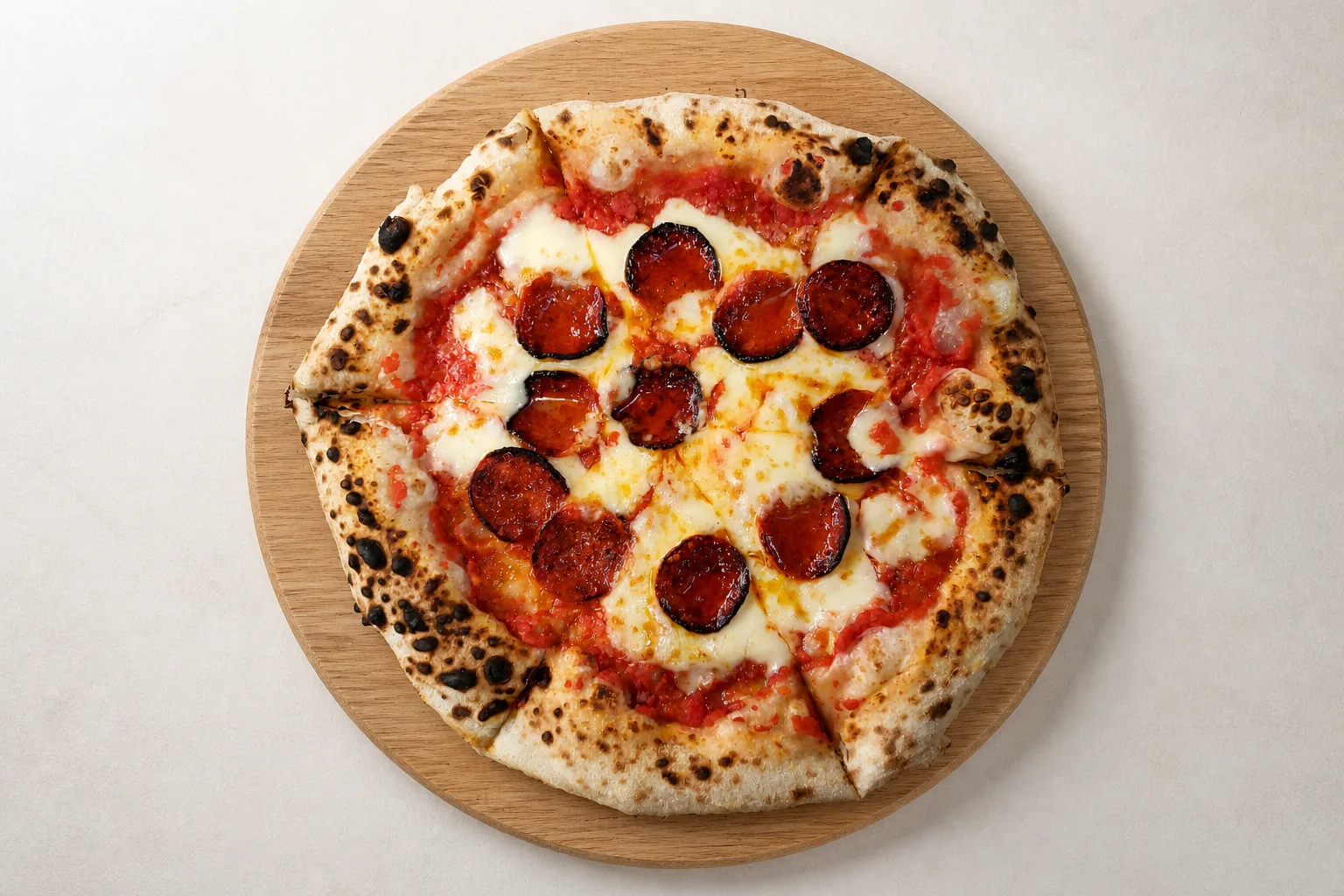
Pizza is the one dish where you choose its silhouette. Shot whole from overhead it is a circle, which the crops treat as a square. Shot as a row of slices it becomes a wide subject, and every crop outcome inverts. Most pizzerias make that choice by accident.
What each platform's crop does to a whole pizza
The item specs below are the platforms' own, checked against their published pages on 2026-08-15 (source list in our DoorDash photo requirements guide).
| Platform | Item ratio | What a whole pizza loses |
|---|---|---|
| DoorDash | 16:9 landscape only | Nothing, but a third of the frame either side is background |
| DoorDash thumbnail | centre-cropped to 1:1 | Nothing — a circle centred in the frame is the ideal case |
| Uber Eats | 5:4 to 6:4 | Nothing at 5:4 |
| Grubhub | 4:3 | Nothing |
| Grubhub desktop header | cropped to 4:1 | The top and bottom of the pie — you are left with a stripe of crust |
A circle's bounding box is a square, so a whole pizza behaves exactly like a burger in the crops: comfortable at 1:1, wasteful at 16:9, destroyed at 4:1. What a pizza has that a burger does not is the option to change shape.
Slices change the outcome, not just the look. Three slices laid in a row is a wide subject. It fills the 16:9 that a whole pie wastes, and it survives the 4:1 header band, because a horizontal strip through a row of slices still shows crust, cheese and toppings. What it gives up is the 1:1 thumbnail, where the outer slice gets cropped away.
So the decision is: whole pie if the 1:1 thumbnail matters most (it is the crop that appears in list views), slices if you need one file that works in a header too. You cannot have both from a single composition.
The problem that is specific to pizza: the box
Pizza is the dish most often photographed in its delivery box, because that is how it arrives and the open lid makes a convenient backdrop. That instinct does cost you something, but not on the rule it usually gets warned about.
The Uber Eats ban on text, logos and watermarks carries an exception for "logos/text on food items the merchant sells or on packaging/plating", and a pizza box is packaging. DoorDash sets the same limit as a single condition: logos and text are acceptable there only when they physically exist on the item. A branded lid in frame is not what disqualifies the shot on either platform. What still fails is branding that was never on the box: a logo composited on afterwards, a promo line set in an editor, the shopfront sign behind the table. The rule turns on what the driver would have carried out of the door. Uber Eats alone closes its exception with "but no profanities allowed", which is the one clause a joke box slogan can cross.
What the box actually costs you is the frame. Uber Eats requires item photos to be "framed in the center", with nothing at the corners or off frame, and a propped-open lid is a large flat panel that takes the top of the picture and pushes the pie down out of the middle of it. Shooting into an open box also fixes the camera at whatever angle the lid leaves room for, which is never the straight overhead a flat round dish needs.
Shoot on a plain board or a plain steel tray. If the box has to be in shot for scale, take the lid off or lay it flat, and keep the pizza centred.
Toppings are a misrepresentation question, not a styling one
DoorDash's rules include a misrepresentation clause: the image has to show the dish your kitchen actually sends out. Pizza is unusually exposed to this, because topping density is the easiest thing in food photography to overstate — a photograph with twice the pepperoni of a real order is the textbook version of the problem the rule exists for.
Count what goes on a real one, and use that count.
The shot that covers four of the five crops
Shoot one master at 4:3, at least 2400 × 1800 px, from directly overhead, pizza centred with margin on all four sides, on an unbranded surface. Every ratio above except the 4:1 header crops out of that file, and the 4:1 needs a slices composition instead.
Overhead is not a stylistic preference here — a flat round dish has no side profile worth showing, and any tilt turns the circle into an ellipse that then crops unevenly.
See how MenuFactory works — generating both the whole-pie and the sliced composition from one source photo is cheaper than shooting the same pizza twice before it goes cold.