AI Ramen Photography for Delivery Menus
A ramen bowl is a circle, which the square thumbnail loves and the wide frame wastes. The deeper conflict is that the angle the crop wants is the angle that flattens the broth.
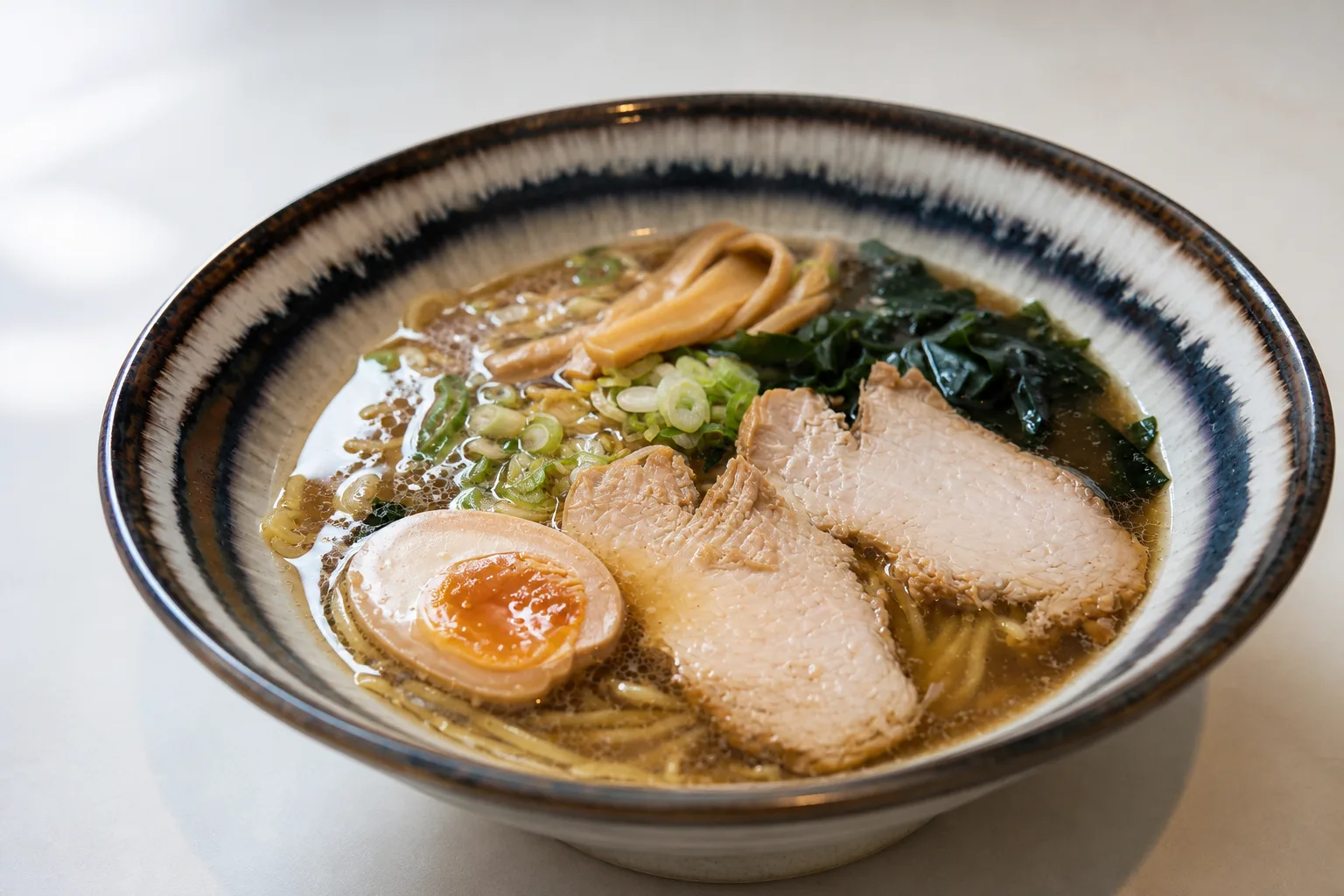
Ramen has a conflict built into it that most dishes do not. Its footprint is a circle, and circles want to be shot from overhead — that is the angle where a round bowl fills a square thumbnail perfectly. But overhead is the one angle where a bowl of soup stops looking like a bowl of soup.
What each platform's crop does to a ramen bowl
The item specs below are the platforms' own, checked against their published pages on 2026-08-15 (source list in our DoorDash photo requirements guide).
| Platform | Item ratio | What a ramen bowl loses |
|---|---|---|
| DoorDash | 16:9 landscape only | Nothing, but a third of the frame either side is background |
| DoorDash thumbnail | centre-cropped to 1:1 | Nothing — a round bowl centred is the ideal square subject |
| Uber Eats | 5:4 to 6:4 | Nothing at 5:4 |
| Grubhub | 4:3 | Nothing |
| Grubhub desktop header | cropped to 4:1 | The rim and everything below it — the band is a stripe of broth |
The crop table is easy. The angle is not.
Overhead crops best and sells worst
Shot from directly above, a ramen bowl is a perfect circle with its toppings arranged flat, and every crop in the table treats it kindly. It also has no depth. Broth that is four inches deep and broth that is one inch deep look identical from above, and depth is what a customer is paying for.
Shot from a low three-quarter angle, the bowl becomes an ellipse — a slightly wider bounding box that gives up a little of the square crop's tidiness — and the broth acquires a visible surface, a level, and a reflection. The pork sits in something rather than on something.
Take the three-quarter angle. The square thumbnail is forgiving enough to absorb an ellipse; it is not forgiving enough to make a flat bowl look deep.
Steam is real and mostly unphotographable
Steam is what tells a customer the soup is hot, and it is close to invisible in the bright, even light that delivery platforms favour. Steam only reads when it is backlit against something darker than itself.
That puts it in direct tension with platform product-photography convention, which wants a bright, clean, evenly lit item on a light background. On a light background, steam is white on white.
The workable compromise is a darker backdrop behind the bowl only, with the front of the dish still lit evenly, and a light source behind and slightly above. If you cannot arrange that, drop the steam and sell the depth instead — a visible broth level does more work than faint steam does.
What the toppings have to do
Ramen toppings are the menu description made visible: the egg half, the chashu, the nori, the scallion. In a square thumbnail displayed at list-view size, they are also the only things a customer can identify at a glance.
Arrange them touching the near rim rather than centred, so the crop that matters keeps them, and so the low angle does not hide them behind the bowl's own edge.
The shot that covers four of the five crops
Shoot one master at 4:3, at least 2400 × 1800 px, low three-quarter angle, bowl centred with margin all round, toppings toward the camera, plain surface. The 4:1 header is not achievable from a bowl — use a wide dish for that slot.
See how MenuFactory works — broth depth and steam are lighting problems, which is exactly the half of food photography that generation handles without changing what your kitchen sends out.