AI Burger Photography for Delivery Menus
A burger is nearly square in silhouette, which makes it the best-case dish for DoorDash's 1:1 thumbnail crop and the worst-case dish for Grubhub's 4:1 header. Here is the shot that survives all three platforms.
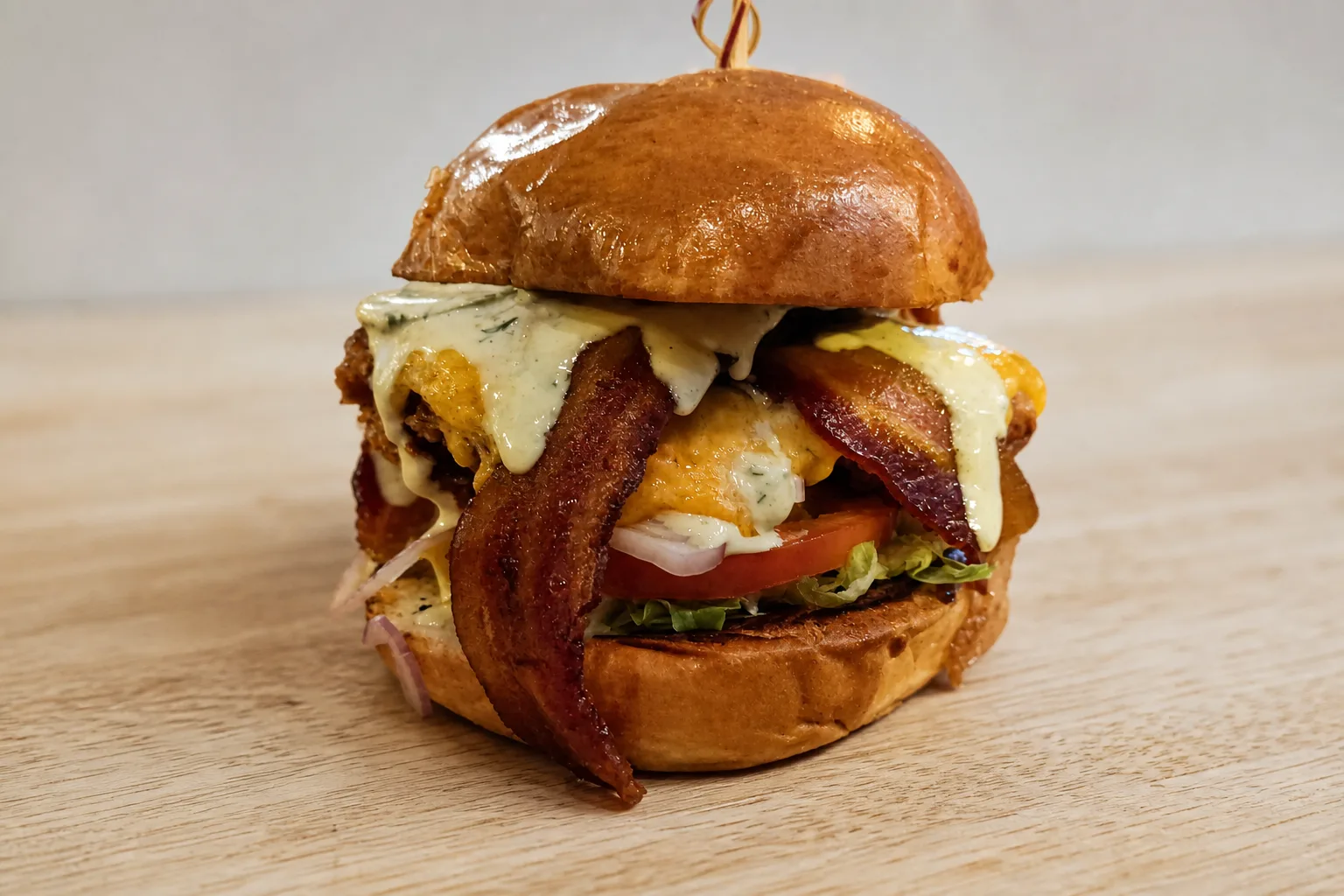
A burger is roughly as tall as it is wide. That one fact decides everything the delivery platforms do to your photo — and it works in your favour on two of them and against you on the third.
What each platform's crop does to a burger
The item specs below are the platforms' own, checked against their published pages on 2026-08-15 (the full source list is in our DoorDash photo requirements guide).
| Platform | Item ratio | What a burger loses |
|---|---|---|
| DoorDash | 16:9 landscape only | Nothing, but two-thirds of the frame is empty |
| DoorDash thumbnail | centre-cropped to 1:1 | Nothing — this is a burger's best crop |
| Uber Eats | 5:4 to 6:4 | Nothing at 5:4; side space returns at 6:4 |
| Grubhub | 4:3 | Nothing |
| Grubhub desktop header | cropped to 4:1 | Both buns — the entire recognition cue |
16:9 is a burger's least efficient frame. A near-square subject in a 16:9 crop occupies a little over half the width, and the rest is background. The obvious fix — adding fries and a drink to fill it — breaks Uber Eats, whose item photos may not show more than one menu item: fries and a drink are two more things you sell separately, and the platform's own example of a violation is a pizza photo that also contains hamburgers. So the burger sits alone in a wide frame, and the empty thirds are the price of a file that works everywhere.
The 1:1 thumbnail is where a burger wins. DoorDash uploads are 16:9, and some surfaces then centre-crop that file to a square thumbnail. For most dishes that crop removes something. For a near-square subject placed dead centre, the square crop is the dish. Almost nothing else on your menu comes through DoorDash's two crops this cleanly.
The 4:1 header is where it dies. Grubhub takes a 4:3 submission and crops it horizontally to 4:1 on desktop web. A 4:1 band across a vertical stack shows a horizontal slice through the middle: patty, cheese, maybe a tomato. Both buns are outside the band. A burger without its bun does not read as a burger, so this is the one crop a burger cannot be composed to survive — it needs a separate, deliberately horizontal shot.
The shot that covers four of the five crops
Shoot one master at 4:3, at least 2400 × 1800 px, with the burger centred and margin on all four sides. Every ratio in the table above except the 4:1 header crops out of that file.
Angle matters more than it does for flat dishes: a low side angle, roughly level with the middle of the stack, is what shows the layers. Overhead turns a burger into a circle of bun.
Two rules that decide a burger shot, and only one of them rejects
Branded wrappers. Burgers are among the most likely dishes to arrive wrapped in branded paper or pinned with a printed flag, and that is allowed. Uber Eats bars item photos that "Contain any text/words" or "Contain logos or watermarks", then prints the exception directly underneath: "Exceptions for logos/text on food items the merchant sells or on packaging/plating, but no profanities allowed." Branded paper is packaging. DoorDash states it as a condition instead of an exception, and ends up in the same position: logos and text are acceptable there "only when they physically exist on the item." What neither allows is a mark that is not physically on the burger or its wrapper: a watermark, a logo composited on afterwards, the shop's signage behind the plate. The exception covers what the kitchen wrapped, not what an editor added afterwards. A paper flag pushed into the bun sits right on the edge of that and is worth thinking about rather than assuming, and a wrapper printed with a slogan is worth reading twice, because "but no profanities allowed" is Uber Eats' clause alone.
Hands. The classic burger hero shot has someone holding it. Grubhub's rejection rules bar body parts, hands included. DoorDash allows them where they do not obscure the item. Uber Eats excepts hands from its no-people rule with no condition attached, which makes Grubhub the one that decides. If you want one file for all three, no hands.
Generating your burger shots instead of arranging one? See how MenuFactory works — it outputs the platform ratios above from a single source photo, so the 4:3 master and the 4:1 header are two exports rather than two shoots.