AI Donut Photography for Delivery Menus
A glaze is a mirror. It reflects your light source, your ceiling and you — and at thumbnail size those reflections stop reading as shine and start reading as blown-out white patches.
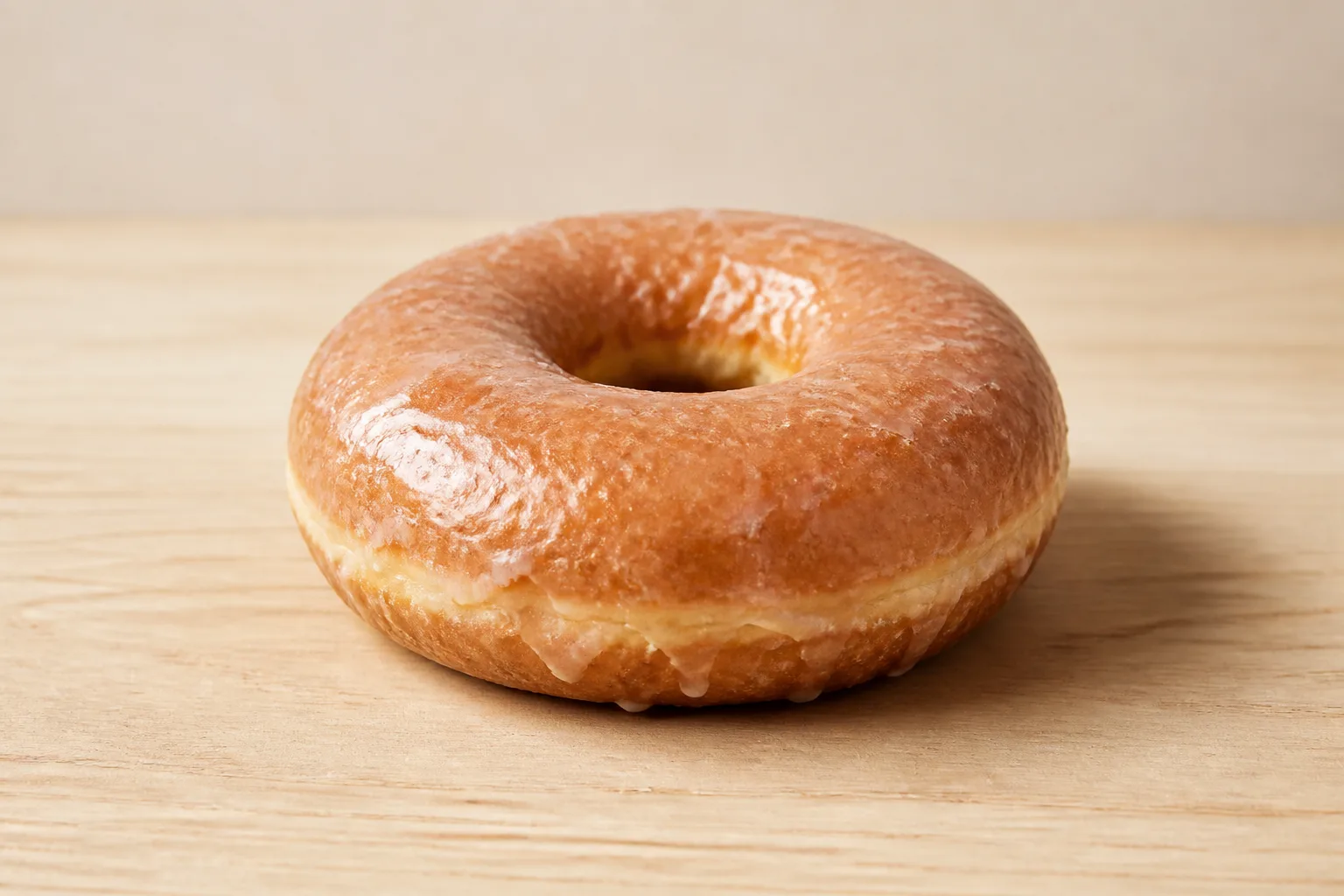
A glazed donut is a curved mirror. Whatever is above it appears on it — the light panel, the ceiling tiles, the phone. That is not a flaw to correct; a glaze that reflects nothing looks dry and stale. The job is to control what it reflects.
Reflections that read as shine, and reflections that read as damage
Point a small bright source at a glaze and you get a hard, sharp white dot. At full size that dot looks like a highlight. At the size the platforms display an item photo in a list view, it is a patch of pure white with no detail in it, and platform re-compression then spreads that patch into a smear.
Use a source that is large relative to the donut and close to it. A big soft source produces a long, gradual highlight that wraps around the curve of the glaze — that gradient is what the eye reads as glossy, whereas a dot reads as overexposed.
Position it off to one side and slightly behind. Directly overhead puts the reflection in the middle of the ring where it competes with the donut itself.
Sprinkles and toppings are the second reflection problem
Anything sitting on the glaze has its own specular surface at its own angle, so a sprinkled donut has dozens of tiny mirrors pointing in random directions. Under a hard light, some of them will catch it dead-on and become individual white dots.
The same fix applies — bigger, softer, further off-axis — and there is a second one specific to toppings: shoot slightly further back and crop in, rather than filling the frame at close range. Distance reduces the angular spread of the surfaces facing the light, so fewer of them hit the reflection angle.
What each platform's crop does to a donut
The item specs below are the platforms' own, checked against their published pages on 2026-08-15 (source list in our DoorDash photo requirements guide).
| Platform | Item ratio | What a donut loses |
|---|---|---|
| DoorDash | 16:9 landscape only | Nothing, but most of the frame is background |
| DoorDash thumbnail | centre-cropped to 1:1 | Nothing — a ring centred is the ideal square subject |
| Uber Eats | 5:4 to 6:4 | Nothing at 5:4 |
| Grubhub | 4:3 | Nothing |
| Grubhub desktop header | cropped to 4:1 | The top and bottom of the ring |
A single donut is a compact subject: comfortable at 1:1, wasteful at 16:9, unusable at 4:1. The temptation, given all that empty width, is to add a second donut, or a row of them, or a coffee.
Resist it on one platform in particular. Uber Eats bars an item photo that shows more than one menu item, its own example being a pizza photo that also contains hamburgers. A dozen-box listing is one menu item and may show a dozen; a single-donut listing photographed beside three other flavours you sell separately is not, and a donut-plus-coffee never is. Accept the empty frame, or fill it with plain background rather than more product.
Glaze sets, and then it dulls
A freshly glazed donut is wet and translucent at the edges. As it cools the glaze sets to a matte, opaque shell. That transition is visible at thumbnail size and it is the difference between "made this morning" and "made yesterday".
Shoot the glaze within minutes of dipping. There is no lighting setup that restores wetness to a set glaze.
The shot that covers four of the five crops
Shoot one master at 4:3, at least 2400 × 1800 px, one donut centred with even margin, one large soft source off-axis and slightly behind, plain untextured surface, freshly glazed. The 4:1 header is not achievable from a single donut.
See how MenuFactory works — a large controlled soft source is the single most expensive thing to arrange in a real bakery, and it is the thing generation supplies for free.