AI Salad Photography for Delivery Menus
A salad is a compact subject that survives the square thumbnail well. The problem is that the two things salads are always photographed with — hands and tongs — are banned outright on Grubhub.
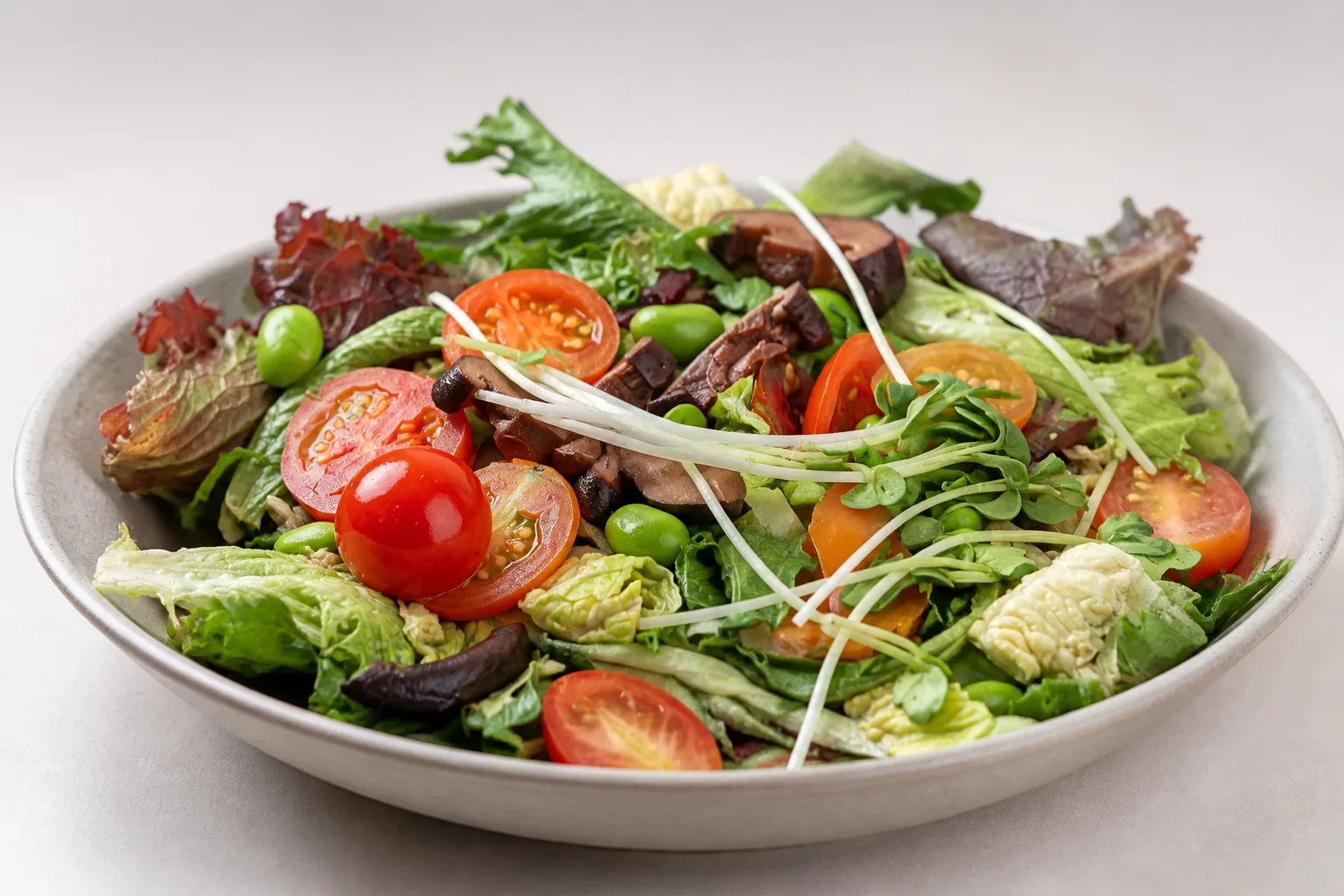
A salad in a bowl is a compact subject, and compact subjects have the easiest time in the platforms' crops. What makes salads hard is everything else: they are the dish most often photographed with hands in frame, and they are the dish that changes fastest while you photograph it.
What each platform's crop does to a salad bowl
The item specs below are the platforms' own, checked against their published pages on 2026-08-15 (source list in our DoorDash photo requirements guide).
| Platform | Item ratio | What a salad loses |
|---|---|---|
| DoorDash | 16:9 landscape only | Nothing, but the sides of the frame are background |
| DoorDash thumbnail | centre-cropped to 1:1 | Nothing — a round bowl is the ideal square subject |
| Uber Eats | 5:4 to 6:4 | Nothing at 5:4 |
| Grubhub | 4:3 | Nothing |
| Grubhub desktop header | cropped to 4:1 | The bowl's rim, top and bottom — the band is a stripe of leaves |
A salad served on a wide platter rather than in a bowl inverts this: it fills the 16:9, survives the 4:1, and loses its edges in the square thumbnail. The bowl is the better default for delivery photography for that reason alone, and it is also what the food actually arrives in.
Two props everyone reaches for, and only one is barred
Hands. The standard salad photograph has someone tossing it, or lifting a forkful, because motion is what makes leaves look alive. Grubhub's rejection rules bar body parts, hands included, and that is the binding constraint: DoorDash allows them where they do not obscure the item, and Uber Eats excepts them outright — its no-people rule reads "Depict people (except for hands)". Upload to all three and Grubhub decides.
Tongs and serving cutlery. Not the same problem, and not the single-item rule — a serving implement is not a menu item. What reaches it is the unsanitary-environment clause, which names used cutlery alongside dirty surfaces and dirty plating. Clean tongs are allowed; tongs smeared with dressing are a stated rejection reason, and keeping them clean through a shoot is harder than deciding not to use them.
Between them, these are the entire visual vocabulary of salad photography, and the one that carries the motion is the one that cannot survive a three-platform upload. What replaces it is height.
Height is the whole job, and it does not last
A dressed salad collapses. The leaves wilt, the volume drops, and what was a mounded bowl becomes a flat one. This is not a slow process — it is the reason restaurant photographers dress salads last and shoot immediately.
Two practical consequences:
- Build the salad taller than you would plate it, then shoot from a low three-quarter angle rather than overhead. Overhead is what the compact footprint invites and it is exactly what hides the height you just built.
- Shoot before dressing where the dressing is served on the side anyway. A dry salad holds its shape for as long as you need.
Also worth knowing: warm continuous lighting accelerates the wilting, and green is the colour that shifts most visibly as it goes. If the greens look duller in the photo than in the bowl, the light has been on too long.
The shot that covers four of the five crops
Shoot one master at 4:3, at least 2400 × 1800 px, bowl centred with margin on all four sides, low three-quarter angle, no hands and no serving implements, cool even light. The 4:1 header is not achievable from a bowl — use a different dish for that slot.
See how MenuFactory works — a generated shot does not wilt between the first ratio and the fourth, which is the practical reason salads are one of the strongest cases for it.