AI Photography for German Restaurant Menus
A schnitzel is pounded until it hangs over the edge of its own plate. DoorDash wants at least 80% of the item visible and the item filling 50% to 70% of the frame, and an item bigger than its vessel has no camera distance that does both.
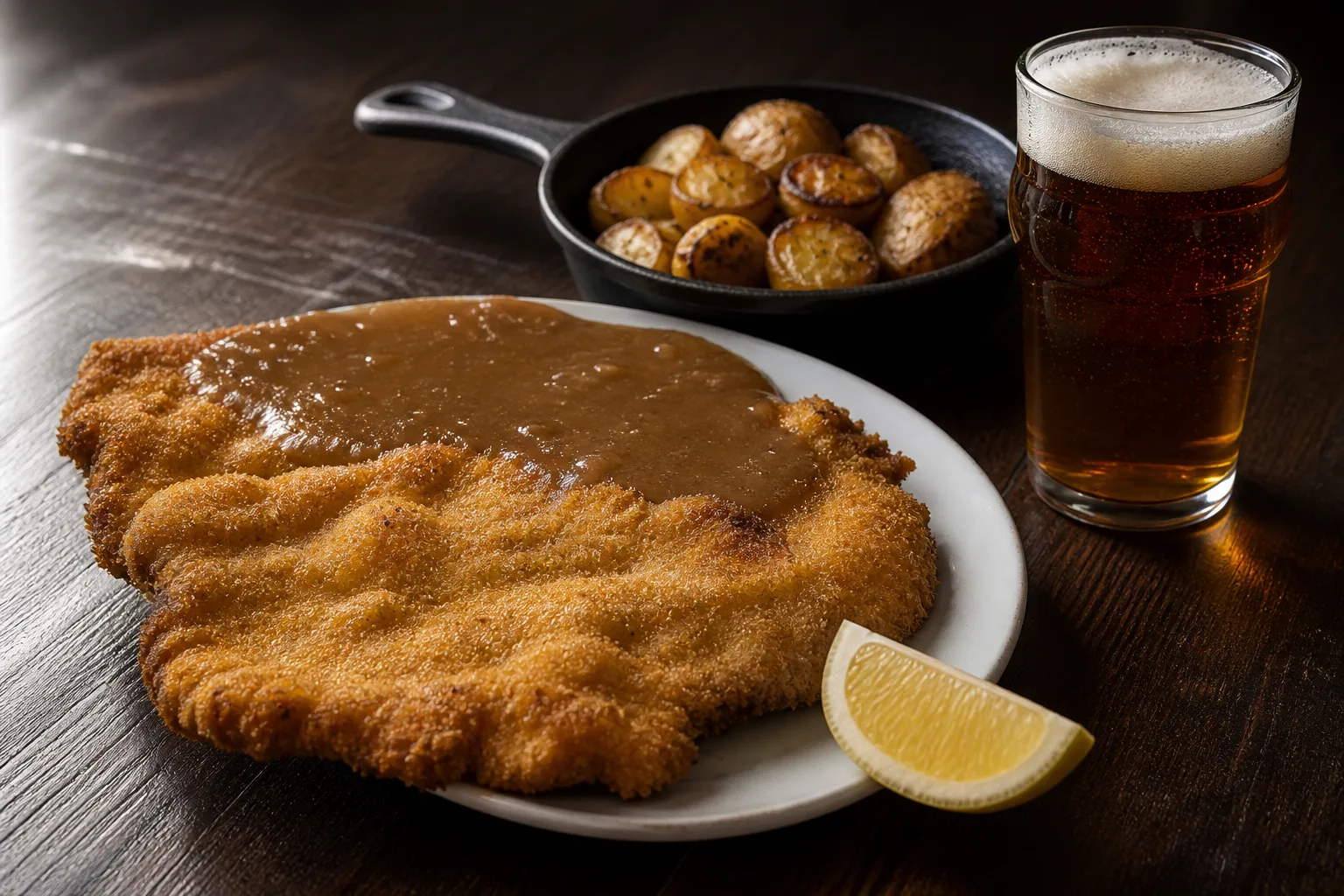
A schnitzel is pounded until it is wider than the plate it is served on. That is the point of it, and no delivery platform's framing rules can accommodate it.
The schnitzel is wider than the plate it arrives on
DoorDash accepts 16:9 landscape only, centre-crops that file to a 1:1 thumbnail on some surfaces, requires at least 80% of the item to be visible, and requires the item to fill 50% to 70% of the frame. Sources are in our DoorDash photo requirements guide.
Both are usually settled by one decision about camera distance. An item that overhangs its own vessel has no such distance: size the cutlet to survive the square crop and it sits under the fill floor in the 16:9 file; size it to fill the 16:9 and the centre crop takes both ends off — the 80% rule from the other side.
So move the plate, not the camera. Turn it until the schnitzel's long axis runs into the frame instead of across it: foreshortening shortens the axis causing the trouble, the bounding box comes closer to square, and the crop keeps the whole cutlet. Overhead gives that axis its full length and flattens the crust while doing it. The wide-platter version, on a wurstplatte, is on the BBQ platter page.
The one place on this menu where a consistent vessel is wrong
Everything else here argues for one setup with the food as the only variable; the drinks column inverts that. A weizen glass, a stange, a seidel and a stoneware krug are not presentation choices — the glass is part of how the style is served, and pouring all four into one house glass for the camera runs at the misrepresentation reason DoorDash names among its eleven.
So the drinks cannot be shot at one distance. Each glass is a different bounding box inside a frame that must be 16:9 landscape, and a tall weizen is the worst of them — the cocktail page works through what that ratio costs a vertical subject. Hold the share of frame height the glass occupies instead, and four shapes still read as one menu. Pour last: the head is the only thing in these frames still changing.
Nothing in the frame is left to say how big it is
A photograph gives scale by putting the food beside something known, and the usual something is the plate rim. Here the rim is under the food. A hand is the usual substitute, and Grubhub is the platform that rules it out: it bars body parts, where Uber Eats excepts hands from its no-people rule with no condition attached and DoorDash allows them when they do not obscure the item. One file for all three cannot have a hand in it. A second dish is out on a different rule — Uber Eats bars mixing menu items in one photo, its published example being a pizza photo that also contains hamburgers.
What is left is whatever the kitchen already sends out on the plate, none of it a listing of its own: the lemon wedge on the Wiener, the parsley on the bratkartoffeln, the ramekin of preiselbeeren beside the Jägerschnitzel. Keep it in frame and it works twice, because nothing else in the picture has colour — schnitzel, pommes, bratkartoffeln, sauerkraut, senf and gravy are one beige-to-brown family.
The table matters for the same reason: the cutlet's outer edge is read against the surface, not the plate. Plain dark wood gives it somewhere to land, and the blue-and-white check from the linen cupboard is a repeating pattern under a flat monochrome object — one you cannot swap afterwards, since composited backgrounds are a named reason.
Where the gravy stops is a plating decision
Jägerschnitzel, Rahmschnitzel and paprika schnitzel are one cutlet at three prices, and the sauce carries all three. Poured over the middle, it covers the breadcrumb crust — the part that took the work, and the only part a photograph can sell.
Pour to one side instead, so the sauce boundary runs along the cutlet rather than over it: the mushrooms or the cream read on one half, the crust holds the other, and one frame carries both the name of the listing and the evidence for it.
The bare half then carries the crust alone, which is the whole reason for leaving it bare — the fried chicken page has the light direction and framing distance that keep a crisp surface reading as crisp.
Pork or veal, and no photograph can tell you which
A veal Wiener Schnitzel and the pork Schnitzel Wiener Art beside it are two listings at two prices, and under the breading they are the same golden oval. No angle, light or plating separates them, because the difference is not visible.
DoorDash names duplicates among its eleven rejection reasons: every unique menu item needs its own photo, and reuse is permitted only for the exact same item — a Beef Taco and a Chicken Taco, in its published example. Read it precisely: it governs reusing a file, not two photographs resembling one another. Beef and chicken in one tortilla would look near-identical too; the example's point is that they still need two files.
Which matters, because the usual answer — plate a difference until the thumbnails separate — is not available here. The only differences you could stage are ones the kitchen does not send: a garnish invented for the veal, a thicker cutlet for the dearer listing. Misrepresentation is one of the same eleven. Two honest files that happen to look alike will pass; one clever file that lies will not.
See how MenuFactory works — six schnitzel listings no camera can tell apart still owe six files, and here that is not six trips to the kitchen.