AI Photography for Greek Restaurant Menus
A Greek kitchen runs a short line — grilled meat, feta, tomato, onion, lemon, oregano, yogurt — and reassembles it into a long menu. The shapes differ; the surface detail does not, and that is what a duplicates rejection is made of.
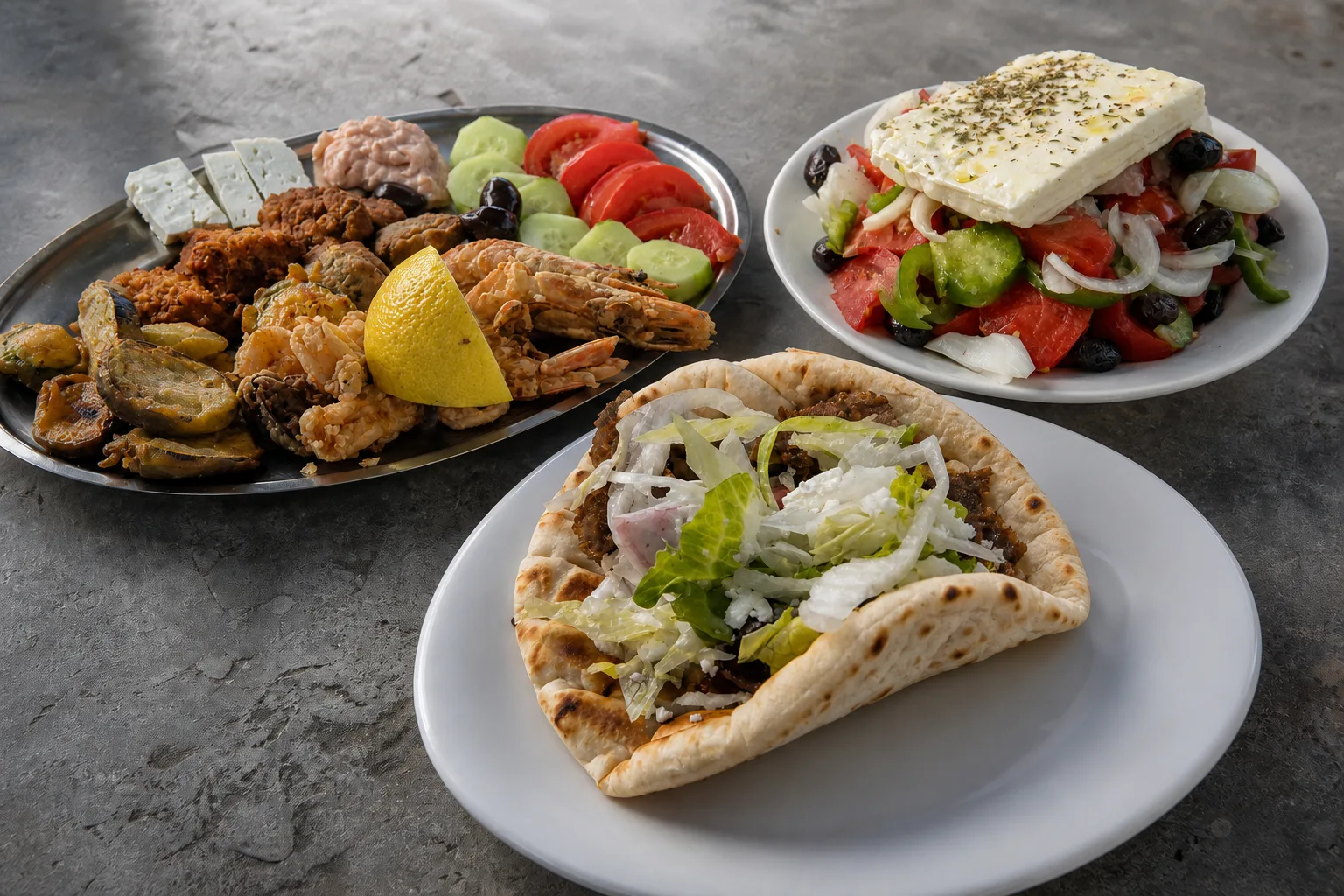
A Greek menu is long and the line it is cooked from is short, so ten listings become ten photographs of largely the same ingredients.
The pantry is shorter than the menu
What a Greek kitchen keeps within arm's reach is grilled pork and chicken, feta, tomato, cucumber, red onion, olives, lemon, oregano and yogurt. The horiatiki, the gyro, the souvlaki pita, the souvlaki plate, the mezze board and the grilled-chicken salad are six listings drawn from that one line.
The silhouettes do vary. Wraps are cylinders whose contents the flatbread hides — the cut-end argument is on the burrito page. Plates and salads are wide irregular spreads that fill a 16:9 upload and lose their edges when DoorDash centre-crops it to a square thumbnail — the salad page. Mezze items are loose pieces, where that crop quietly reduces how many the customer counts — the wings page.
Three shapes is ordinary variety. The Greek problem is what stays constant underneath them: the same white cubes, red wedges, purple rings and green flecks, in the same amber oil.
The cut that rescues a burrito backfires on a gyro
The cut end is the standard fix for a wrapped cylinder: it turns an anonymous beige tube into a picture of what the customer is buying. On a Greek menu it works against you. Cut a pork gyro pita and a chicken souvlaki pita, stand both up, and the cross sections differ by one strip of meat inside an identical field of tomato, onion and tzatziki. Both are legible — about the parts the two items share.
DoorDash names duplicates among its eleven rejection reasons: every unique menu item needs its own photo, and reuse is permitted only for the exact same item, its example being a Beef Taco and a Chicken Taco. Sources are in our DoorDash photo requirements guide. Two Greek wraps are nearly that example.
So still cut, but change what the cut face is arranged around: turn the wrap so the protein is the largest thing in the section and the salad falls behind it, not around it. DoorDash requires the item to fill 50% to 70% of the frame; on this menu, what gets most of that area should always be what differs.
The mezze platter is one item and five listings
A pikilia is usually sold as one thing at one price, which makes it photographable: DoorDash bars hero shots — photos of several items sold separately — but allows one photo of items sold together as a bundle.
The trap is on the other side. Tzatziki, taramasalata, melitzanosalata, tirokafteri and fava also sell individually, and all of them are already in the platter frame. Cropping each dip out of that image for its own listing yields five photos from one file — duplicates and misrepresentation at once, since the crop shows a portion nobody is served.
Shoot the platter as the platter, then shoot each dip on its own. That is the cheapest work on this menu, because the dips are where the cuisine's colours finally separate: pink taramasalata, grey-brown melitzanosalata, orange-red tirokafteri, yellow fava. Same bowl, identical framing, and colour tells five listings apart on its own.
Feta, tzatziki and a white plate
Greek food carries an unusual load of white: cubed and crumbled feta, tzatziki, yogurt, the inside of a pita. On a white plate on a white table the camera has three whites to separate, and the food is the one that loses.
DoorDash's background rule is simple, non-distracting and natural; white passes only when it looks natural, and solid colour fills and composited backgrounds are named causes for rejection. Cutting the plate out onto white is not the escape route.
The fix is the surface. A mid tone with real texture — worn wood, unglazed terracotta, grey stone — gives feta an edge to sit against and stays inside the rule, because it is a real surface photographed as itself. It also does the job usually handed to a blue-and-white tablecloth, without the pattern.
Decide what differs, then plate for it
Cook one round of pork and one of chicken, then shoot the gyro pita, the souvlaki pita and the souvlaki plate consecutively under one unchanged light. Look at the three thumbnails side by side, at the size a customer sees them.
If you cannot tell which is which, the answer is not a better photograph of any one of them. It is choosing, per listing, the one element allowed to dominate the frame — the char on the pork, the lemon on the chicken, the height of the feta slab — and plating so it sits closest to the camera. Composition carries the difference the ingredients do not.
See how MenuFactory works — holding one setup across a dozen listings that share their ingredients, and varying only the element that differs, is the repetitive work that is expensive by hand and cheap here.