AI Chicken Wing Photography for Delivery Menus
Wings are the dish people photograph with their hands, and hands are exactly what Grubhub's rejection rules bar. What replaces them is sauce that reads as wet without blowing out.
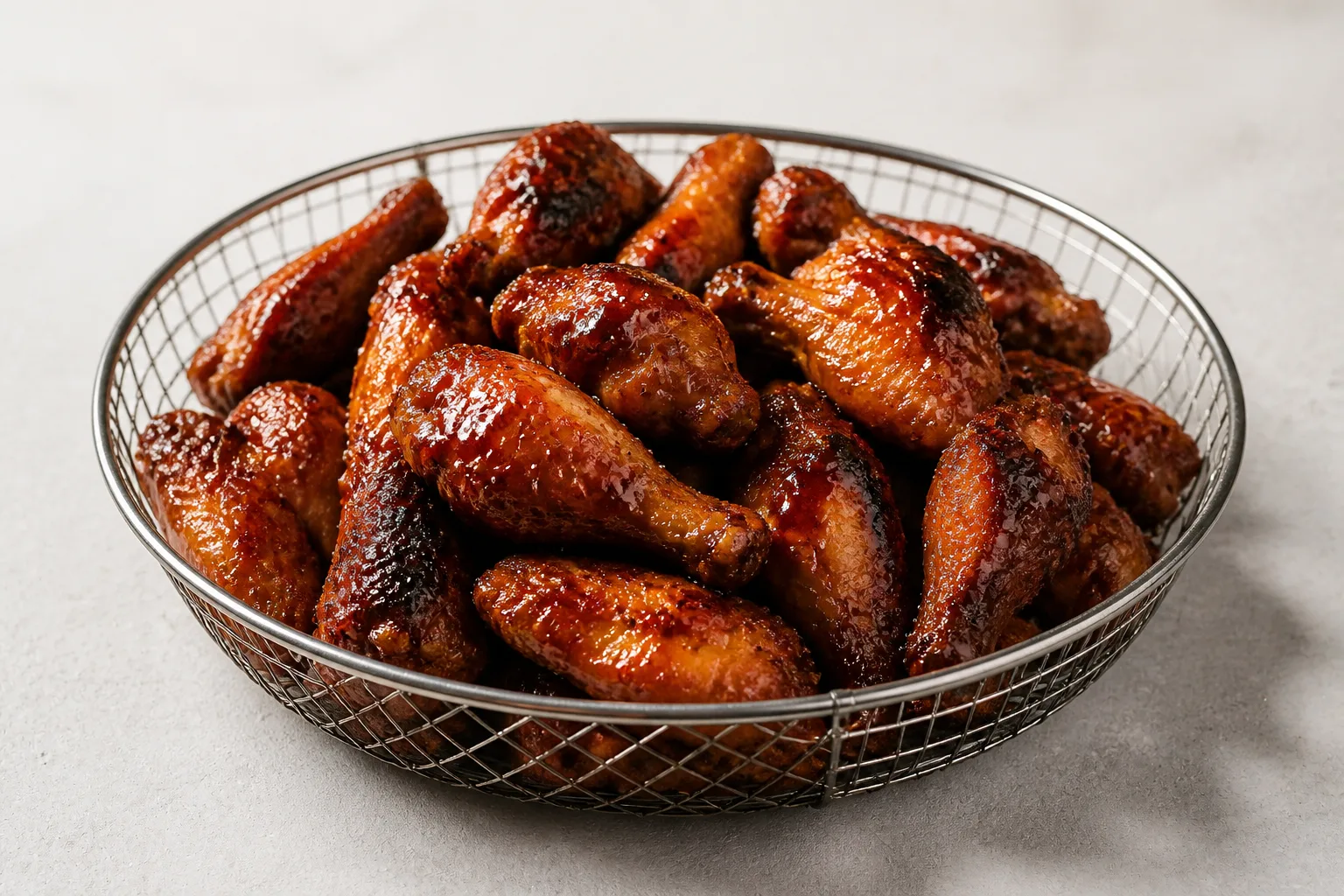
Wings are hand food, and hand food gets photographed by hand. Somebody lifting a wing, sauce stretching, is the single most common composition in the category — and it is the one composition that cannot be uploaded to Grubhub at all.
The hands rule, stated exactly
Grubhub's rejection rules bar body parts, hands included, and that is the strict end of the range rather than the middle of it. DoorDash allows hands in limited cases, provided they do not obscure the item. Uber Eats is the most permissive of the three: its no-people rule is written "Depict people (except for hands)", and that exception carries no condition at all.
So the composition that most defines wing photography clears two platforms out of three, and Grubhub is the one that rejects it. Keeping it means keeping a second, hands-free file alongside it for Grubhub; for a menu with six sauce variants that is six extra shoots to preserve one visual idea.
If you want one file that goes everywhere, drop the hands. What has to do their work is sauce.
What each platform's crop does to a pile of wings
The item specs below are the platforms' own, checked against their published pages on 2026-08-15 (source list in our DoorDash photo requirements guide).
| Platform | Item ratio | What a pile of wings loses |
|---|---|---|
| DoorDash | 16:9 landscape only | Nothing — a spread pile fills a wide frame |
| DoorDash thumbnail | centre-cropped to 1:1 | The outer wings, which reads as a smaller portion |
| Uber Eats | 5:4 to 6:4 | Little at 6:4 |
| Grubhub | 4:3 | Nothing |
| Grubhub desktop header | cropped to 4:1 | Little — a spread of wings is a workable horizontal band |
Wings are forgiving in every crop except the square, and the square is forgiving too if you pile rather than spread. A heap in a basket has a compact bounding box and reads as more food than the same wings laid flat, which is the rare case where the better-cropping composition is also the more appetising one.
Sauce has to read as wet without blowing out
A glossy sauce is specular: it reflects the light source directly. Point a small bright light at a tray of buffalo wings and every wing gets a hard white dot on it. At thumbnail size those dots are not gloss, they are blown-out pixels — pure white with no detail, which platform re-compression then smears into patches.
Use a large soft source, positioned to the side and slightly behind, so the highlight becomes a long soft band along the top of each wing rather than a point. That band is what reads as wet.
The second half of it is timing. Sauce soaks into the coating and goes matte as it sits. Toss and shoot immediately, and re-toss between takes rather than trying to fix it in the edit.
Dry rubs have the opposite problem
A dry-rub wing has no gloss to manage and no colour to speak of — it is a brown object on a brown pile. What carries it is texture, which needs raking light from a low side angle, the same treatment fried chicken needs and the opposite of what a saucy wing wants.
If your menu has both, they are two lighting setups, not one.
The shot
Shoot one master at 4:3, at least 2400 × 1800 px, wings heaped rather than spread, large soft side-back light for sauced, low raking side light for dry rub, no hands, plain unprinted basket. This crops to every ratio above including the 4:1 header.
See how MenuFactory works — sauce gloss is a lighting problem, and lighting is the part of a wing photo you can change without changing what lands in the box.