AI Photography for Pizzeria Menus
A whole pizza is the only food that naturally fills a 4:1 header band. Pizzerias are the one business whose hero product fits the hardest crop on the platform — and most of them never use it.
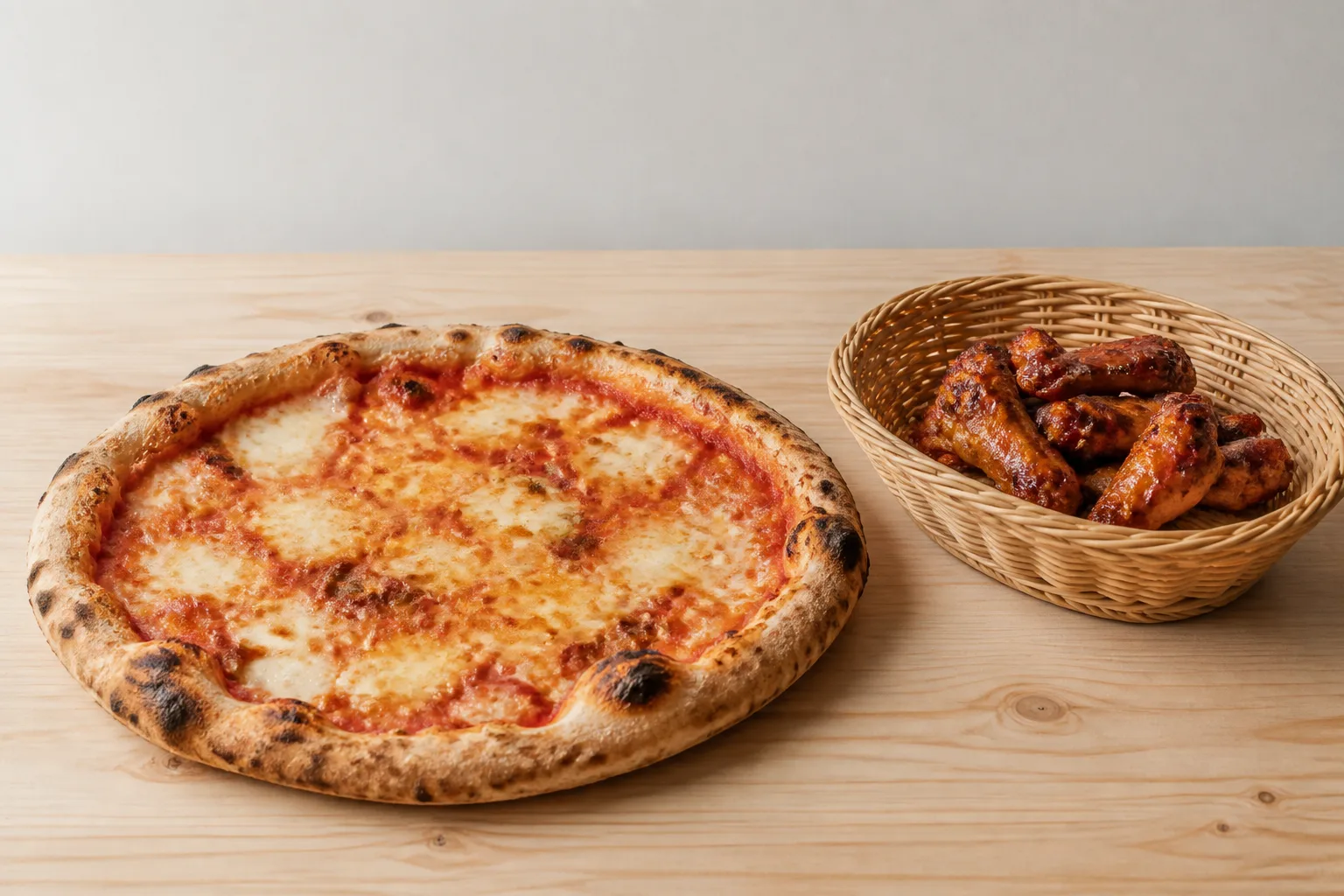
Storefront header images are the most neglected asset on every delivery platform, and pizzerias have the least excuse. The header is a wide band — and a pizza, sliced and fanned, is the only common menu item whose natural silhouette is a wide band.
The header band is a pizzeria's free advantage
The specs are the platforms' own. DoorDash's header is 1400 × 800 px, displayed at 4:1 on web and 16:9 in the app. Grubhub's is submitted at 4:3, at least 2400 × 1800 px, and cropped horizontally to 4:1 on desktop web — a behaviour documented on its developer portal rather than a merchant help page, which is why most guides miss it. Sources are in our DoorDash photo requirements guide.
A 4:1 band destroys nearly every food. A burger loses its top and bottom, a bowl becomes a stripe of broth, a tall glass is unusable. A row of pizza slices, or a whole pie shot slightly off-centre, sits in that band as though it were designed for it.
DoorDash's own merchant research — a study of over 15,000 local small business merchants covering April to June 2022 — reports that menus with header images see up to 50% more monthly sales. That figure applies to every cuisine; the point here is that pizzerias are the ones who can satisfy the hardest crop without a compromise.
Compose the header at 4:3 with the pizza spanning the horizontal centre, and check the middle 4:1 band before uploading. If the band alone still reads as pizza, the asset works on both platforms and in both DoorDash surfaces.
Whole or slice is the decision that shapes the item photos
A whole pizza shot from overhead is a compact subject: it sits perfectly in DoorDash's 1:1 thumbnail and leaves the sides of the mandatory 16:9 frame as background. A slice, or a fanned set of slices, is wide: it fills the 16:9 and loses its outer edges when the square crop lands. The trade-off, and what the crust and the cheese need from the light, is on the pizza page.
The decision is worth making once for the whole menu rather than per listing. Mixing whole pies and slices across item photos makes a grid of thumbnails look inconsistent for no gain, and whole pies are usually the right answer because the thumbnail is where most of the traffic is.
Wings are the other half of a pizzeria menu and the other silhouette: several pieces that a square crop will trim, changing the count a customer sees. Heaping rather than spreading is the fix, and the wings page covers it. Salads and garlic knots behave as wide spreads, the ground covered on the salad page.
Toppings are the only thing separating one listing from another
DoorDash names duplicates among its eleven rejection reasons: every unique menu item needs its own photo, and reuse is permitted only for the exact same item. On a pizzeria menu that means every specialty pie needs its own frame, and every specialty pie is a disc of the same diameter with a different scatter on it.
Two things make the difference legible at thumbnail size. Shoot close enough that individual toppings have real size in the frame rather than fitting the whole board in with margin to spare. And let each pizza's topping distribution be genuinely its own — pepperoni evenly spaced, vegetables clustered, a white pie with visible ricotta mounds — rather than styling every pie into the same even scatter.
The box is the delivery reality and it is not the photograph
Pizza arrives in a printed box, and it is tempting to photograph it that way because that is what the customer receives. The branding is not what stops you. Uber Eats bars text, logos and watermarks in item photos and then excepts "logos/text on food items the merchant sells or on packaging/plating" — a printed box is packaging, and that is materially the carve-out DoorDash grants for a logo that physically exists on the item. The one condition Uber Eats attaches and DoorDash does not is "no profanities allowed", which on this menu means reading the slogan on your own lid before you frame it.
What the box costs you is frame. DoorDash wants the item filling 50% to 70% of the photo with at least 80% of it visible; an open lid takes the top of a 16:9 and the near edge of the base takes the bottom, and the pie is left occupying a third of a picture it was meant to fill.
Photograph the pizza on a plain board. The product is the same product; the box is the part of the frame that is not selling anything.
Build the header first
Build the header image first, before any item photo. It is the one asset your product is unusually well suited to, it is the one most competitors have left as a default, and shooting it first tells you the light and surface you will use for everything else.
See how MenuFactory works — a header that survives its 4:1 crop is a composition problem you can iterate on for free here, rather than a shoot you get one attempt at.