AI Photography for Polish Restaurant Menus
Żurek arrives in a bowl you can eat. Once the vessel is an ingredient, every framing rule the delivery platforms publish is measured against an edge you had to draw yourself — and so is the number of photographs you owe.
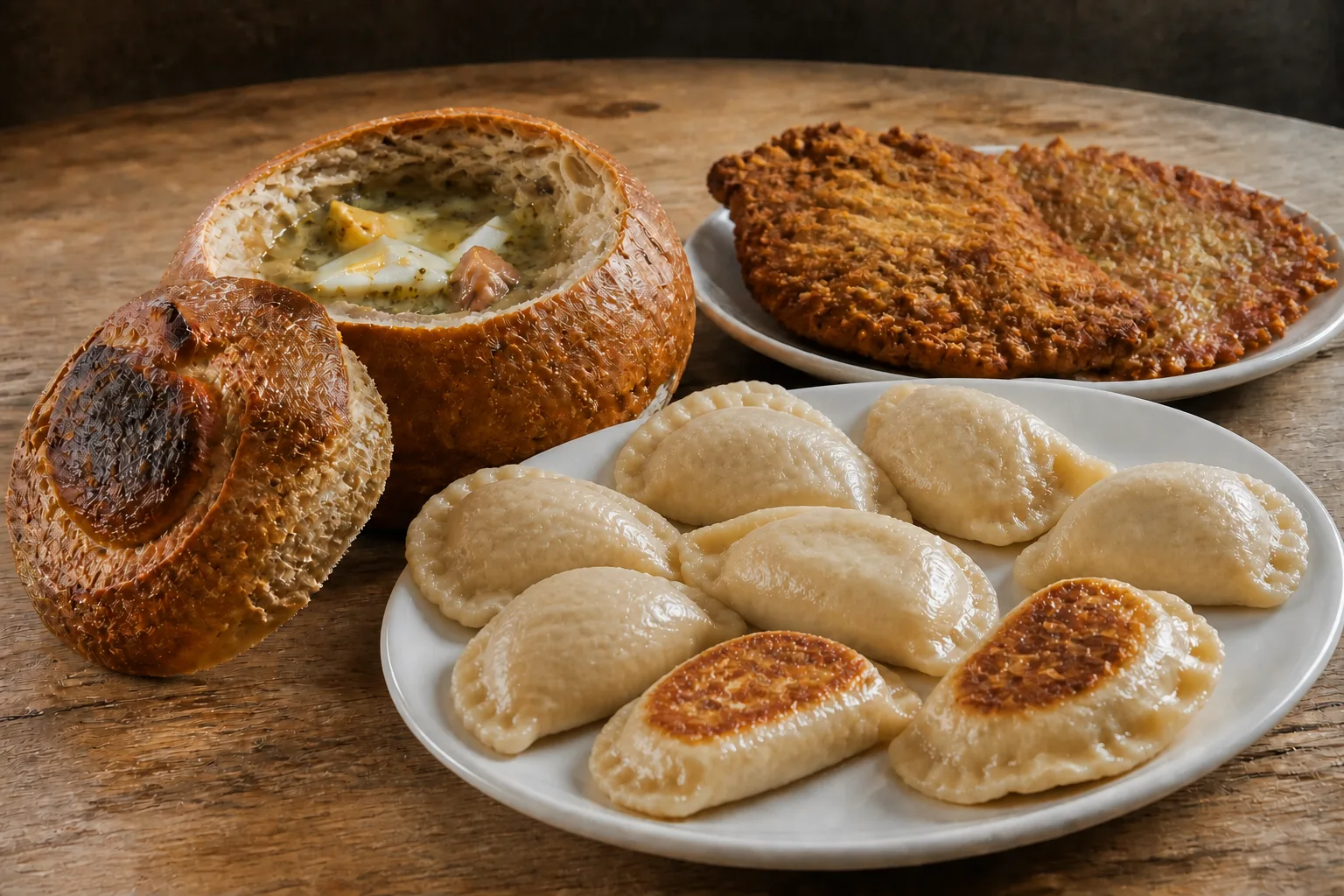
Żurek arrives in a bowl the customer eats. That one fact moves the edge of the item, and every framing rule the delivery platforms publish is measured from that edge.
The bowl is sometimes an ingredient
A plate is packaging: it holds the item and is not the item. A hollowed rye loaf is not packaging — it is baked, served, eaten, and part of what the price bought.
DoorDash requires at least 80% of the item to be visible and the item to fill 50% to 70% of the frame; sources are in our DoorDash photo requirements guide. Tighten onto the soup and you have not framed the item more closely, you have left most of it out — advertising a bowl while the kitchen sends a loaf. That is misrepresentation, another of the eleven named rejection reasons.
The fill rule is the awkward half: the loaf dwarfs the soup, so a properly filled frame leaves the soup a small disc inside it.
One angle shows the loaf, the other shows the soup
Straight down, that disc is the whole photograph and the loaf is reduced to a rim: circular, brown, and at thumbnail size indistinguishable from a ceramic bowl. The fact that justifies the listing vanishes in the angle that shows the soup best.
Drop to a low three-quarter and it is bread again — crust under raking light, the cut-off top leaning against it showing crumb, sausage and halved egg standing above the surface and breaking the outline. The cost is the soup, now a narrow ellipse.
No angle pays both, so fix the compromise: high enough that the surface stays an open ellipse, low enough that the loaf keeps a lit side wall. Every other bowl wants that camera anyway, since overhead flattens the depth separating a thin broth from a thick one — the ramen page works through it.
The vessel does both jobs at once
DoorDash names duplicates among those eleven reasons: every unique menu item needs its own photo, and reuse is permitted only for the exact same item — its published example is a Beef Taco and a Chicken Taco.
Where the vessel is sometimes an ingredient, that rule cuts both ways at once. Żurek in a loaf and żurek in a bowl are the same soup and not the same item: two listings, two prices, two photographs. Barszcz, rosół and żurek in three identical white bowls are three items that photograph as one.
So the vessel does both jobs — the whole difference between two listings here, the whole reason two collapse there. Where it separates nothing, the separation has to sit above the rim: uszka in the barszcz, noodles and carrot in the rosół, sausage and marjoram in the żurek.
Pierogi are sold by the count, not by the piece
Pierogi, placki ziemniaczane and kopytka are the flat rounds: compact, low, croppable in any ratio a platform asks for, because nothing important lives at the edge of a single piece — the pizza page works that through on a whole circle.
A pierogi listing is not one piece, though. It is a plate of a stated number, and the number is part of what is bought. DoorDash accepts 16:9 landscape only and centre-crops it to a square for some surfaces, so a plate framed edge to edge loses its outermost pieces on the way to the thumbnail, which then shows a smaller portion than the kitchen ships. That is arithmetic, not identity: keep the whole plate inside the square, and fan the pieces so each crimped edge stays readable.
Boiled and fried are two listings of one dough
The same kitchen sells the same pierogi twice: gotowane and odsmażane — boiled, or boiled and then pan-fried. Same dough, same filling, same count, two prices, and the entire difference is a surface.
That is a compression problem before it is a lighting one. DoorDash caps a menu item photo at 2 MB and platforms re-encode what you upload; fine texture is the first thing a lossy encoder discards, and colour detail goes before luminance. The breading on a kotlet schabowy, the lacy edge of a placek and the browned face of an odsmażany pieróg are the same kind of detail. Raking side light renders it as small shadows rather than small colour shifts, which is the version that survives — the fried chicken page covers distance and direction.
Count the item edges, not the recipes
This kitchen cooks fewer foods than the menu lists: one dough becomes two listings, one soup becomes two listings, one potato becomes placki and kopytka. Each pair is two items under the duplicates rule, so the number of photographs you owe is the number of item edges, not the number of recipes.
That number is the bill. Photographers price per image or per dish, and the advice to shoot only your five to ten signature dishes assumes the rest of the menu can share — but the pairs sharing a recipe here are exactly the pairs that are not the exact same item. All three routes are costed in our menu photography cost comparison.
See how MenuFactory works — one soup that has to be photographed twice, once in a bowl and once in a loaf, is two setups by hand and one here.