AI Photography for Deli and Sandwich Shop Menus
A deli menu is twenty-five listings that are all, unavoidably, a sandwich. The cut face is the only thing that separates one from another, which makes where you cut a merchandising decision.
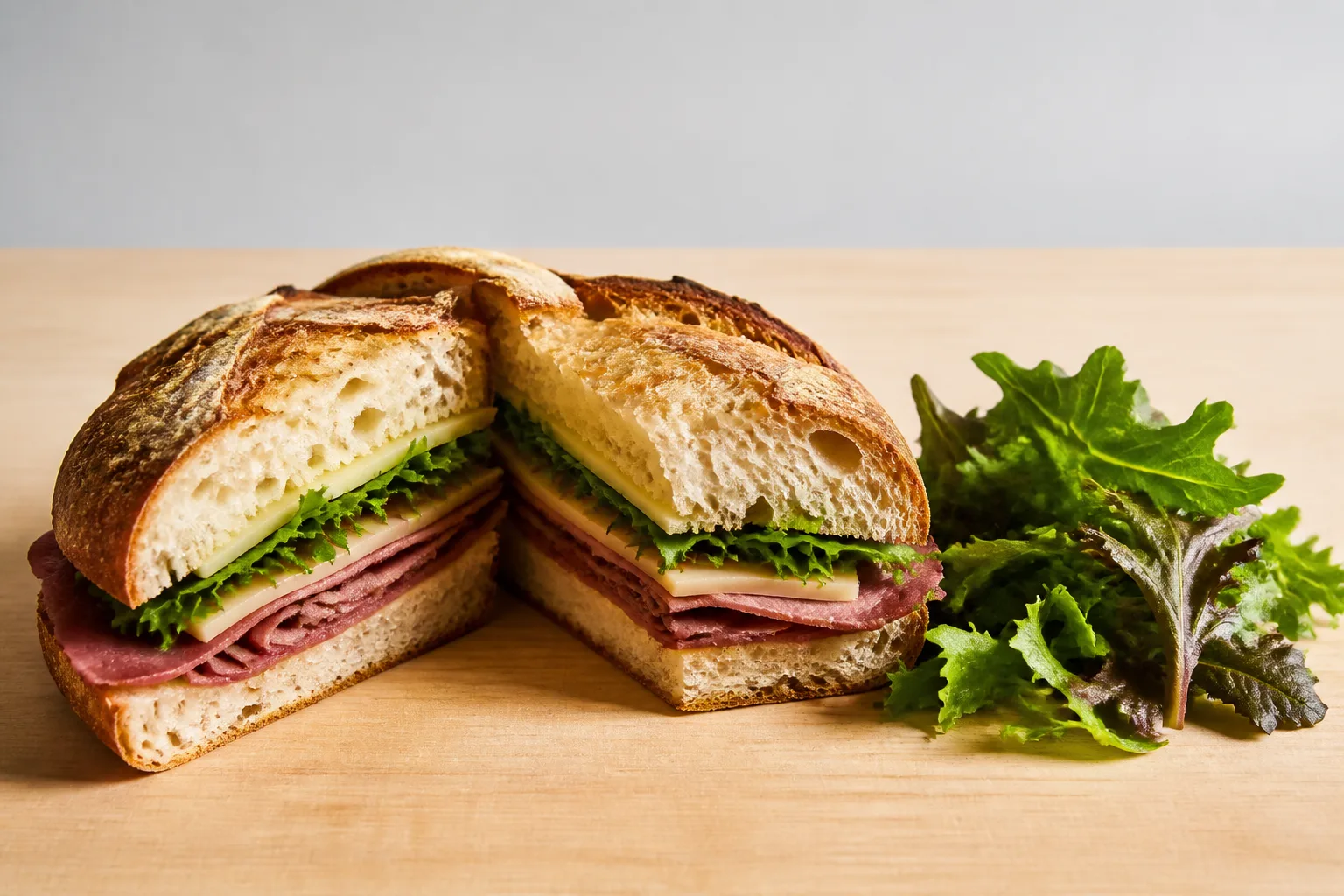
No other cuisine concentrates this hard on one silhouette. A deli's entire menu is bread with things between it, and from the outside every listing on it is a beige wedge. The differentiation problem is not a styling challenge here — it is the central design constraint of the whole shoot.
The cut is the photograph
DoorDash lists duplicates among its eleven named rejection reasons: every unique menu item needs its own photo, and reuse is permitted only for the exact same item — its published example being a Beef Taco and a Chicken Taco, two products that look nearly identical and still require separate images. Sources are in our DoorDash photo requirements guide.
A turkey club, an Italian sub and a pastrami on rye are three of those. Whole and unturned, they are three photographs of bread.
Which means the cut face is doing all the work, and where you cut decides how much of the filling shows. Cut straight down through the centre on a tall stacked sandwich and the layers present as a clean cross section. Cut on the diagonal and the face is larger, showing more of the filling but at a shallower angle. Neither is universally right: a sandwich whose selling point is quantity wants the diagonal's larger face, and one whose selling point is a specific layer — the pastrami, the fresh mozzarella — wants the straight cut that shows that layer at full thickness.
Make that decision per sandwich, and make it deliberately. It is the highest-leverage thing on a deli shoot and it takes no equipment.
Two shapes, and the footprint changes with the plating
The club sandwich page works through a finding that matters more here than anywhere: two halves laid side by side is a wide subject that fills a 16:9 frame and loses its outer edges in DoorDash's square thumbnail, while the same two halves leaned against each other is a compact subject that survives the square intact. The sandwich did not change; the plating did.
Because a square thumbnail is where most of your traffic looks, lean them. Keep the flat, spread-out plating for anything you need in a header band.
Salads and sides are the menu's other shape, and a dressed salad collapses as it sits, losing the height that distinguishes a generous bowl from a mean one — the salad page. Black-and-white cookies, cheesecake and layer cakes behave as stacks whose cut face is again the informative view, on the cake page.
Bread is the variable nobody photographs deliberately
A deli usually sells the same fillings on four or five breads, and on many menus those are separate listings. Rye, sourdough, a hero roll and a wrap are genuinely different products in the frame — different colour, different crumb, different silhouette — and that is a differentiator worth using rather than standardising away.
It also cuts the other way. If your listings are filling-based and bread is a modifier, then shooting each filling on a different bread makes the set look inconsistent for no reason. Decide which axis your menu actually sells on, and let the photography follow it.
The chip bag is a second item, not a text problem
Delis ship a sandwich with a bagged chip and a pickle more reliably than almost any other kind of kitchen, and the bag is printed.
Uber Eats bans text, logos and watermarks in item photos and then names an exception for logos and text on the food a merchant sells and on its packaging or plating, with the one added condition that nothing profane appear; DoorDash draws the same line, accepting branding that physically exists on the item. So the print on the bag is not what disqualifies the photograph. The bag is. A bagged chip is a listing you sell on its own, and Uber Eats states its single-item rule with an example — a photo for pizza should show only pizza, not pizza and hamburgers — which is what a sandwich and a bag of chips in one frame amounts to.
Shoot the sandwich. The chip belongs in the description.
Keeping a stack from slumping
A tall sandwich is held together by nothing, and it starts settling as soon as it is cut. Mayonnaise and warm fillings accelerate it, and a slumped stack reads as a smaller sandwich than the one you sell.
Build it, cut it, and shoot it in that order without pausing — camera framed and exposed on a stand-in first. If a sandwich needs a pick to hold, use the pick you actually serve it with, and leave it in the frame.
Cut it both ways and look at the thumbnails
Start with your best-selling sandwich and shoot it cut both ways — straight and diagonal — before deciding anything else. Looking at those two thumbnails side by side is the fastest way to learn which cut your particular fillings need, and that one decision then applies to most of the menu.
See how MenuFactory works — a menu this uniform lives or dies on consistency between listings, which is exactly the thing that drifts when twenty-five sandwiches are shot across several sessions.