AI Club Sandwich Photography for Delivery Menus
A club sandwich is stacked like a burger but sits wide, not round. That reverses the outcome on two crops: it fills DoorDash's 16:9 and then loses half of itself in the 1:1 thumbnail.
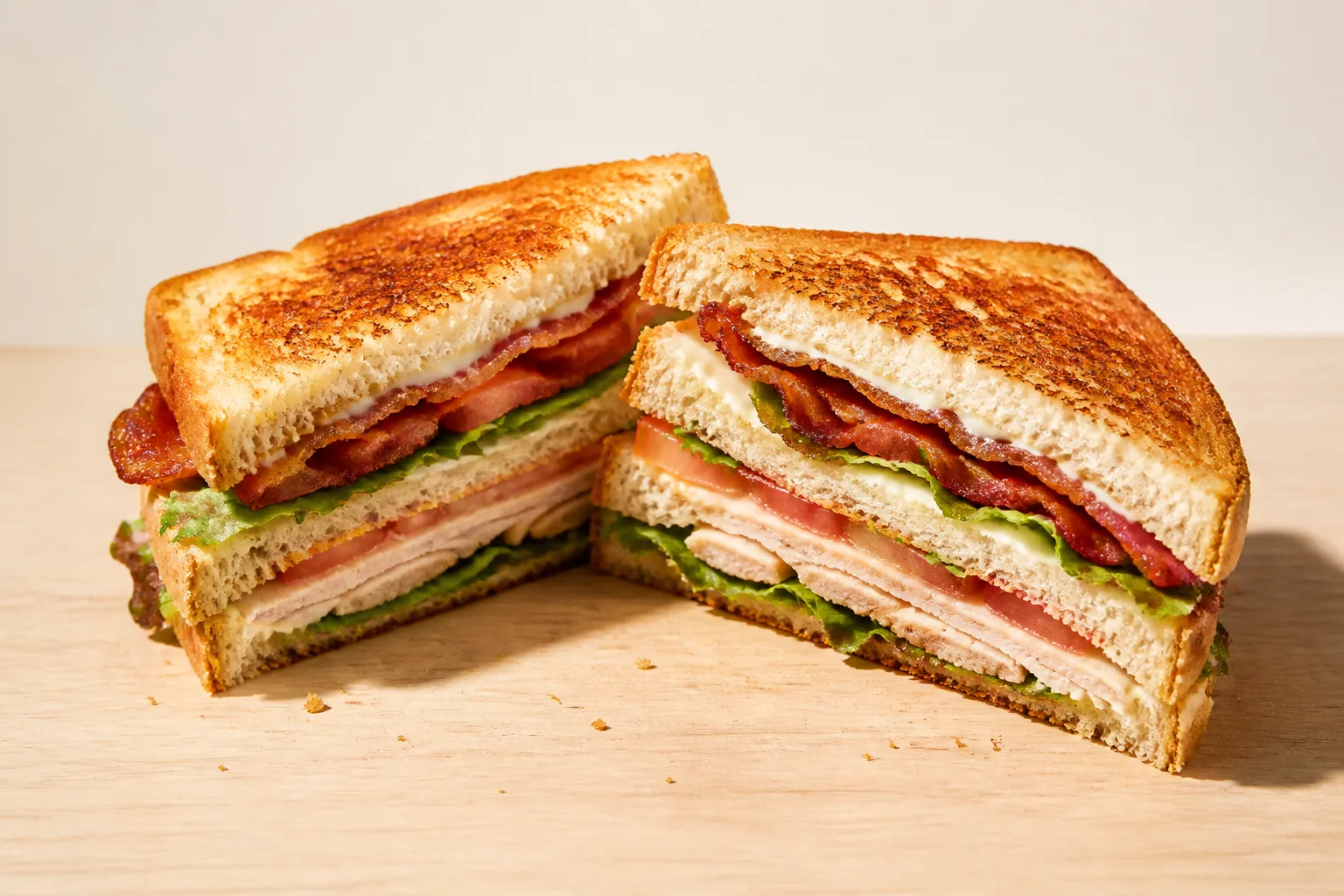
A club sandwich has the same stacked height as a burger and behaves almost nothing like one in a crop. The difference is footprint: a burger is round and compact, a club sandwich is two or four triangles sitting side by side. Wide, not round — and the platforms treat those two silhouettes in opposite directions.
What each platform's crop does to a club sandwich
The item specs below are the platforms' own, checked against their published pages on 2026-08-15 (source list in our DoorDash photo requirements guide).
| Platform | Item ratio | What a club sandwich loses |
|---|---|---|
| DoorDash | 16:9 landscape only | Nothing — a wide subject fills a wide frame |
| DoorDash thumbnail | centre-cropped to 1:1 | The outer half, if the halves are lined up |
| Uber Eats | 5:4 to 6:4 | Nothing at 6:4; the outer edges tighten at 5:4 |
| Grubhub | 4:3 | Nothing |
| Grubhub desktop header | cropped to 4:1 | Little — the band lands on the cut faces |
16:9 is a club sandwich's natural frame. Two triangular halves side by side is a landscape composition already. Where a burger leaves two empty thirds, a club sandwich fills the width. This is the crop a burger struggles with and a club sandwich is built for.
The 1:1 thumbnail is where it loses. Lay the two halves out in a row and DoorDash's centre crop takes a square out of the middle: you get one full triangle and a sliver of the second. The fix is composition, not cropping — nest the halves instead of lining them up, one leaning against the other so the pair's bounding box comes closer to square. That single arrangement decision is worth more on this dish than any lighting choice.
The 4:1 header is survivable here, which it is not for a burger. A 4:1 band across a club sandwich lands on the cut faces, and the cut face is where the layers are. The band shows bacon, tomato, and lettuce in section — the most informative slice of the dish. It only works if the cut faces are pointed at the camera, which brings up the constraint that has no equivalent on a burger.
Orientation is a hard constraint, not a preference
A burger reads as a burger from any direction. A club sandwich reads as a club sandwich only from the cut side: turn it 90 degrees and it is a stack of bread. The cut faces have to face the camera in every shot, and any crop that removes them removes the dish's identity even while the frame is still full of food.
The shot that covers four of the five crops
Shoot one master at 4:3, at least 2400 × 1800 px, halves nested rather than lined up, cut faces to the camera, centred with margin on all four sides. That file crops down to every ratio above, including the 4:1 header — the one crop a burger needs a second shoot for.
The rejection rule to watch
Club sandwiches are pinned with picks, and picks are frequently frilled, printed, or branded. Uber Eats bars item photos that "Contain any text/words" or "Contain logos or watermarks", and the very next line gives that ban its limit: "Exceptions for logos/text on food items the merchant sells or on packaging/plating, but no profanities allowed." DoorDash grants the same thing from the other direction — logos and text are acceptable there "only when they physically exist on the item." So a branded box or a printed wrapper is settled on both platforms, and so is the mark that is definitely out: a watermark, a logo composited on afterwards, the shop's sign in the background.
A pick is the part that is not settled. A printed pick pushed into a sandwich is not obviously the food, and not obviously the packaging or the plating either, and nothing Uber publishes resolves which it is. Nothing published resolves which it is, so this is a judgement rather than a rule: a plain wooden pick removes the question, a printed one leaves you making the argument to a reviewer.
See how MenuFactory works if you would rather generate the ratios than shoot them — the nested-halves master and the 4:1 header come out of one source photo.