AI Photography for Israeli Restaurant Menus
Six listings leave an Israeli kitchen on the same round plate, and what separates them sits inside a well swept into the spread. Below the rim is where this menu keeps its differences, and it is the one place a crop cannot reach.
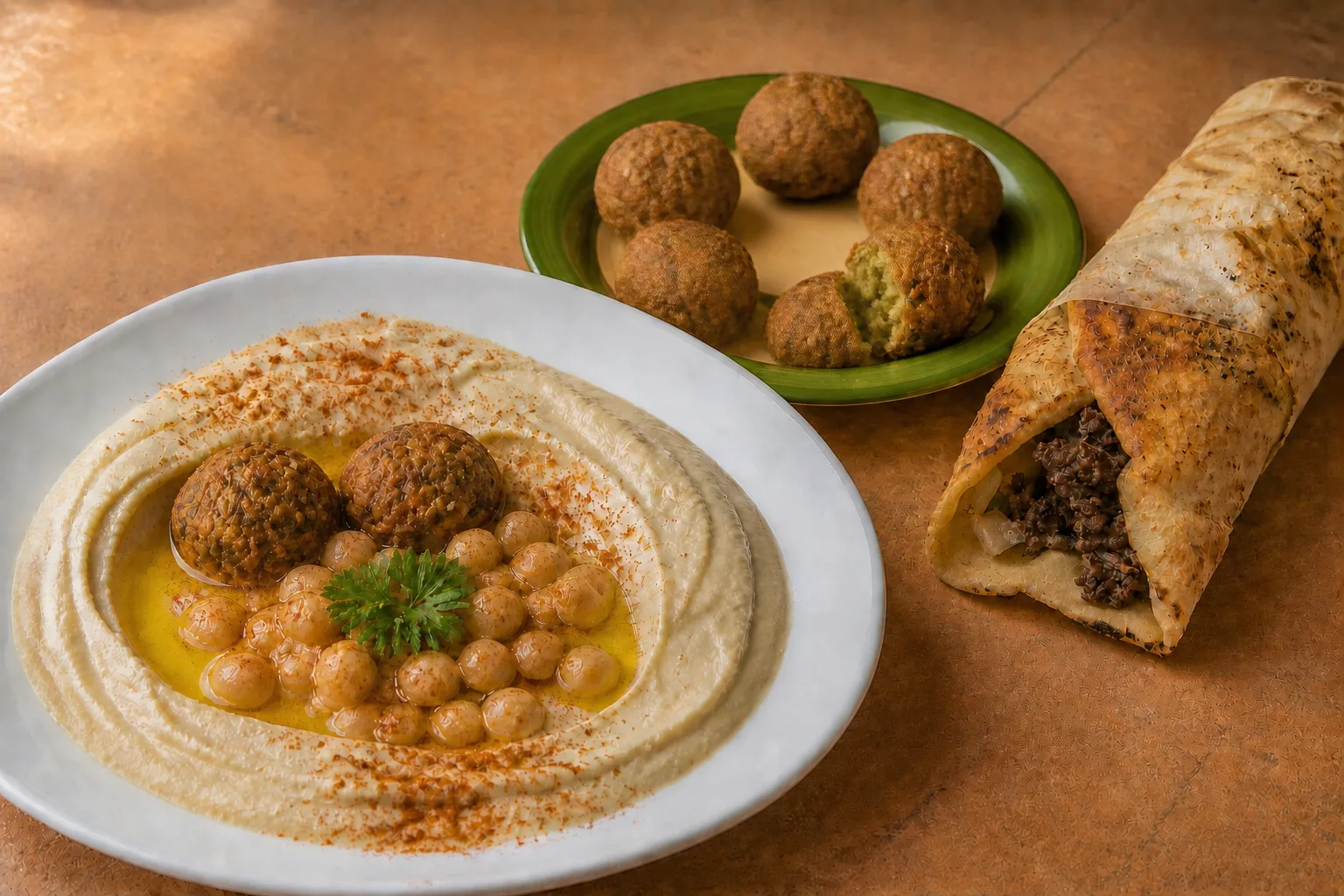
An Israeli menu lists six things that arrive on the same round plate, and every difference between them sits below the rim.
The shapes on this menu are stacked inside each other
Most menus spread their shapes across their listings. A hummus counter stacks them into one object. The plate is flat, the spread is the vessel, and a well swept into it holds what is being sold — oil and warm chickpeas for masabacha, ful, fried mushrooms, ground meat, tahini. Falafel is set into that well rather than beside it; shakshuka repeats the pattern with countable eggs in a liquid surface. The pieces and the surface are not two listings but one plate, and the identity of that listing is its lowest layer.
DoorDash names duplicates among its eleven rejection reasons: every unique item needs its own photo, and reuse is permitted only for the exact same item, its example being a Beef Taco and a Chicken Taco. Sources are in our DoorDash photo requirements guide. Those two differ at the mouth of the shell; hummus and hummus ful differ inside a hollow.
Filling the frame and seeing into the well pull opposite ways
DoorDash requires the item to fill 50% to 70% of the frame, accepts 16:9 landscape, and centre-crops to 1:1 for some surfaces. A round plate that must fill that much of a frame that may become square pushes the camera up and back, and overhead is where a circle sits most comfortably in a square.
Overhead is also where a well stops being a well: the groove flattens to a ring of shading, the oil reads as a stain rather than a pool, and chickpeas standing proud lie down into a scatter. Poke is the exception that proves it — its product sits on the surface, which is why the poke bowl page says shoot straight down. This plate hides its product underneath.
The window is narrow: high enough that the far wall of the well clears the near rim, low enough that the rim still casts an edge. Deepen the well to widen it rather than climbing.
What sits proud of the rim is the whole listing
Only what stands above the spread is unambiguous at thumbnail size, so plate the difference upward: chickpeas heaped until their tops break the line, ful mounded rather than smoothed, mushrooms leaning on each other, falafel set half in and half out. Below the rim you have colour; above it you have silhouette, and silhouette is what survives the crop.
The plate must be the plate you serve — misrepresentation is a named rejection reason — but nothing dictates where in the well each element lands, and on a falafel plate the balls belong in it rather than ringed outside it, where the square crop takes the outermost first.
The salads on the table are not the ones on the menu
Salatim arrive with the meal and appear on no line of the menu: pickles, matbucha, cabbage, and the chopped salad that is elsewhere a listing of its own and loses height while you work — the salad page has that clock. They are what makes a table look like the restaurant, which is why they creep into frame.
Uber Eats requires an item photo to show a single item; DoorDash bars a photo of several items sold separately and excepts only what is sold together as a bundle. Salatim are not sold at all, so the exception never reaches them, and inside an item frame they read as part of the portion.
Erasing them afterwards is a background removal job, and our guide to it covers why a lifted dish looks like a sticker with no ground beneath it. Clear the table before the shot instead.
The one listing that seals its own stack
Sabich and a laffa shawarma are the only items here that hide their layers, which makes the wrap the one place where the stack has to be rebuilt for the camera rather than simply plated. The cut-face argument itself is on the burrito page.
What is specific here is that the section is wet: amba, tahini and warm egg make a face that slumps as soon as the knife leaves it. So assembly order decides the picture — lay the aubergine and egg slices against the side you mean to cut, and cut immediately before the frame.
Two camera heights, and the order to shoot them in
Shakshuka is this menu's other bowl, and its vessel is not edible: a deep cast-iron pan whose walls hide its own surface from a low camera, holding yolks that set while you work. It wants the camera higher; the hummus row wants it lower. Shoot the pan first, then drop to well height and run the row without touching the light: plain, masabacha, ful, mushroom, meat, falafel.
Look at that row at thumbnail size before you break the setup down. Two plates you cannot tell apart there are asking for a deeper well and a higher heap, not a better exposure.
See how MenuFactory works — holding one camera height across six plates that differ only below the rim is the part of this menu that stops being a scheduling problem here.