AI Photography for Japanese Restaurant Menus
A Japanese menu is built from two shapes — bowls and scattered pieces — and both of them make every item look like the item above it. The crop is not the hard part. Telling twenty rolls apart is.
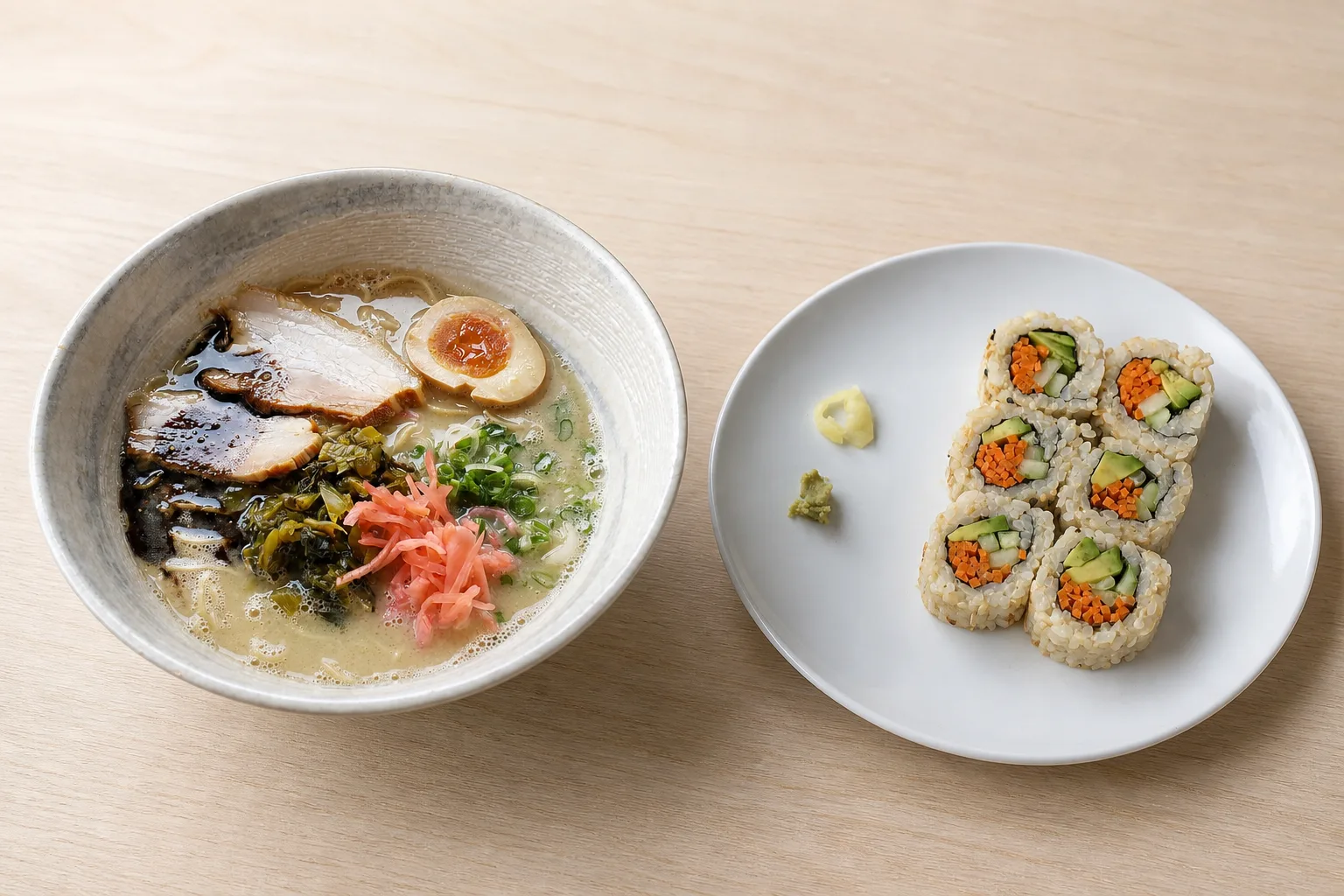
Almost everything on a Japanese delivery menu is one of two things: something in a bowl, or a set of pieces arranged on a board. Donburi, ramen, chirashi and udon are bowls. Sushi, sashimi, gyoza and yakitori are pieces. That is a narrow vocabulary, and it creates a problem that no single photograph can solve.
Two shapes, and the crop each one costs you
A bowl is a compact, roughly circular subject. It sits well in DoorDash's 1:1 thumbnail and wastes most of the 16:9 frame it has to be uploaded in, and its depth — the thing that distinguishes a rich broth from a thin one — disappears entirely when shot from overhead. The ramen page and the poke bowl page work through the angle that keeps it.
Scattered pieces are the opposite: wide, and the square thumbnail cuts the outer ones off. For sushi that is not merely a composition problem, because the number of pieces a customer sees changes. The sushi page covers the arrangement that survives it.
Neither of these is hard to fix once. The problem is that almost every item on the menu is one of these two shapes, so you are not solving it once — you are solving it on every listing, against the item directly above it in the list.
The rejection reason nobody plans for is duplicates
DoorDash's rejection article lists eleven named reasons, and one of them is duplicates: every unique menu item needs its own photo, and reuse is permitted only for the exact same item. DoorDash's own example is a Beef Taco and a Chicken Taco — near-identical products that still require separate images. (The full list and its sources are in our DoorDash photo requirements guide.)
Now apply that to a sushi menu. A spicy tuna roll, a salmon avocado roll and a California roll are three rice cylinders of the same diameter, cut into the same eight pieces, arranged on the same board. They need three photographs, and those photographs need to be distinguishable at thumbnail size by a customer who is scrolling.
The same is true of your bowls. Tonkotsu, miso and shoyu ramen photographed from the same angle under the same light are three pictures of a beige circle.
This is a menu-level problem with a menu-level answer: decide, before you shoot anything, what visually separates each item from its neighbours, and make that the thing the photo is about. For rolls it is usually the filling at the cut face — so shoot at an angle that shows the cut face rather than the top. For broths it is colour and topping placement, which means the same three-quarter angle for all of them but a deliberate difference in how the egg, chashu and nori sit.
The scheduling problem this cuisine has and others do not
The two halves of a Japanese menu want opposite conditions.
Raw fish is at its best for a few minutes. The surface is wet and specular when it is cut and goes matte as it dries, and that sheen is the entire freshness signal. It wants to be shot immediately, cold, under soft indirect light.
Ramen is the reverse. The steam that reads as hot is barely photographable, the noodles keep absorbing broth and swelling, and the nori softens against the rim. It also wants to be shot immediately — but immediately after a completely different kitchen process.
You cannot batch these. A shooting session that does all the bowls and then all the sushi will produce good bowls and dried-out fish, or the reverse. Shoot in pairs: one bowl, one board, alternating, with the camera and lighting fixed so that only the food changes.
That fixed setup is also what makes the finished set read as one menu rather than as a pile of separate attempts.
Your three best sellers, at thumbnail size
Pick your three best sellers and shoot those first, with the setup you intend to use for everything else. If those three are distinguishable from each other at thumbnail size, the setup is right and the rest of the menu is execution. If they are not, no amount of care on the rest of the menu will fix it.
See how MenuFactory works — holding one look steady across a whole menu is the part that is genuinely hard to do by hand, shoot after shoot.