AI Photography for Thai Restaurant Menus
Green curry, red curry, yellow curry. On a Thai menu the colour is the product name, which makes colour accuracy a labelling question rather than an aesthetic one.
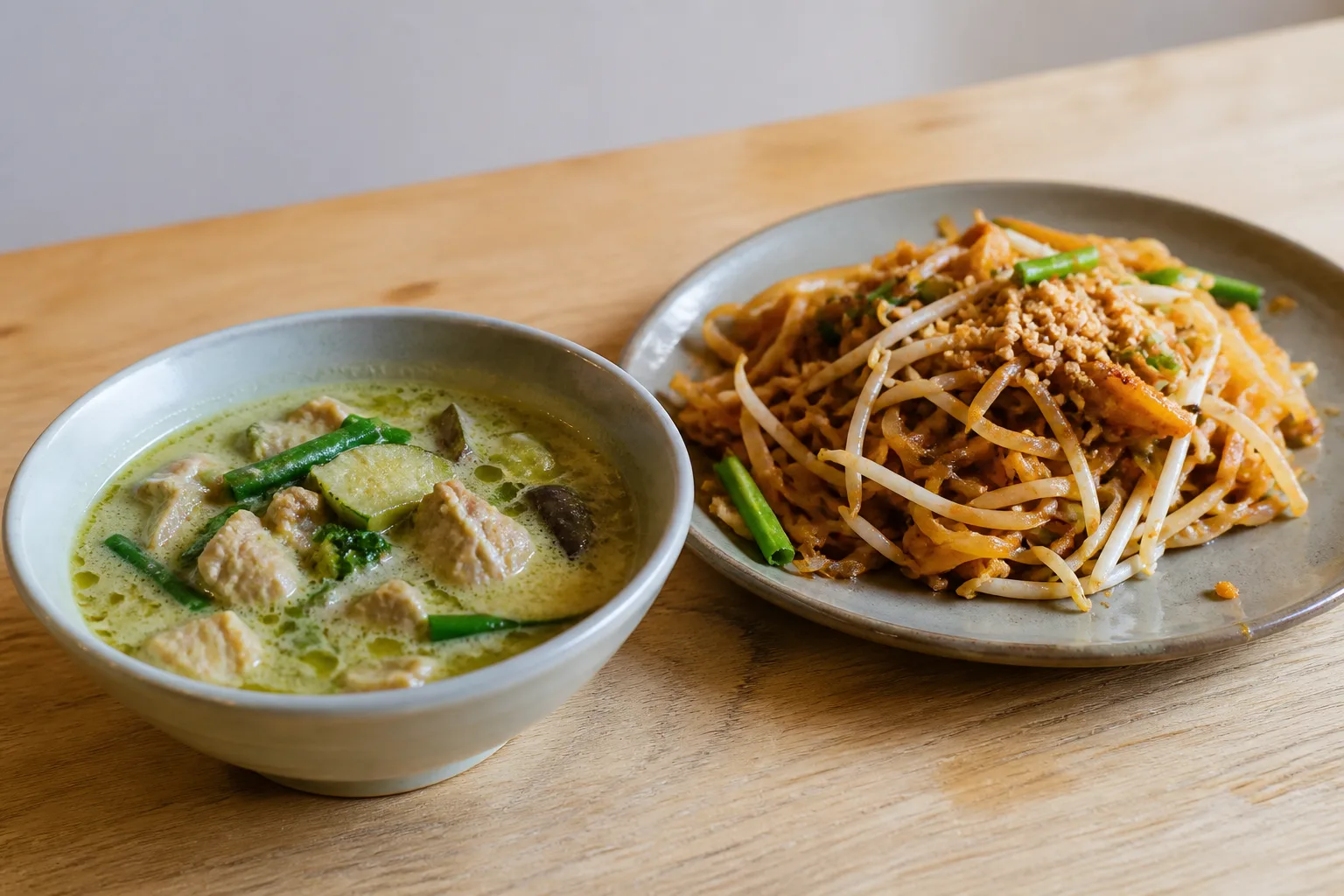
Most cuisines can survive a photograph whose colour is slightly off. Thai cannot, because on a Thai menu the colour is the item name. A customer ordering green curry is ordering the colour. If your photograph of it reads olive or grey-brown, the image is not merely unappetising — it is describing a different product from the one on the listing.
Colour accuracy is a labelling problem here
Curry paste occupies a narrow band, and the three headline curries sit close together within it. Green, red and yellow are separated by less than most menus assume, and the separation is exactly what a warm or cool light source destroys: under warm light a green curry drifts toward olive, under cool light a red curry goes brown.
This matters more here than it would on another menu because the platforms display your image directly beside a competitor's image of the same named dish, at thumbnail size, where colour is close to the only signal left. A green curry that reads grey next to a green curry that reads green loses on a distinction that is purely photographic.
Shoot under neutral, indirect light, and judge the result against the actual bowl rather than against the screen. The curry page works through the rest of what a thick sauce needs, including why a three-quarter angle shows a sauce's body where an overhead shot does not.
Two shapes, and the rice decision that follows
Thai menus run on bowls — curries, tom yum, boat noodles — and wide plates: pad thai, larb, som tam, stir-fries. Two shapes, and they crop in opposite directions. The bowl is compact and survives DoorDash's 1:1 thumbnail intact while wasting most of the mandatory 16:9 frame. The plate fills the 16:9 and loses its outer edges the moment the thumbnail crops it, which is the behaviour the salad page covers for any wide spread. Noodle bowls sit between the two, and the depth problem they share with ramen is on the ramen page.
Where the rice sits decides which of those two a curry listing becomes. A bowl of curry with rice plated beside it is a wide arrangement, and the square crop will take the rice off, leaving a bowl of sauce as the image a customer scrolls past. Plate the rice behind the bowl and slightly overlapping and the pair reads as one compact subject that survives the crop.
Where a Thai menu trips the duplicates rule
DoorDash names duplicates among its eleven rejection reasons: every unique menu item needs its own photo, and reuse is permitted only for the exact same item — its example being a Beef Taco and a Chicken Taco. The full list and its sources are in our DoorDash photo requirements guide.
Thai menus hit this from an angle most cuisines do not: the protein matrix. Green curry with chicken, with beef, with tofu and with shrimp are four listings of the same sauce in the same bowl. So are pad thai with each of the same four.
Because the sauce is identical by definition, the protein is the only thing that can separate the images, and it has to be visibly at the surface rather than submerged. Lift nothing that would not surface on its own — that is the territory DoorDash's misrepresentation rule covers — but do plate so that the pieces which naturally break the surface are facing the camera.
Herbs are the freshness signal and they wilt fastest
Thai plating leans on fresh herbs: basil on a curry, cilantro and crushed peanut on a pad thai, mint in a larb. Heat takes them down quickly — basil laid on a hot curry darkens and collapses within a short time, and a wilted leaf reads at thumbnail size as old food.
Garnish last, shoot immediately, and garnish the amount that actually ships. Herbs added for the photograph and left out of the container are the same misrepresentation problem as anything else added for the camera.
The two-bowl test
Photograph your green curry and your red curry back to back under the same light, then look at the two thumbnails together. If a stranger cannot tell which is which, the light is wrong, and nothing further down the menu will fix it.
See how MenuFactory works — neutral colour across a whole menu shot on different days is the hard part by hand, and it is the part that stops being a variable here.